
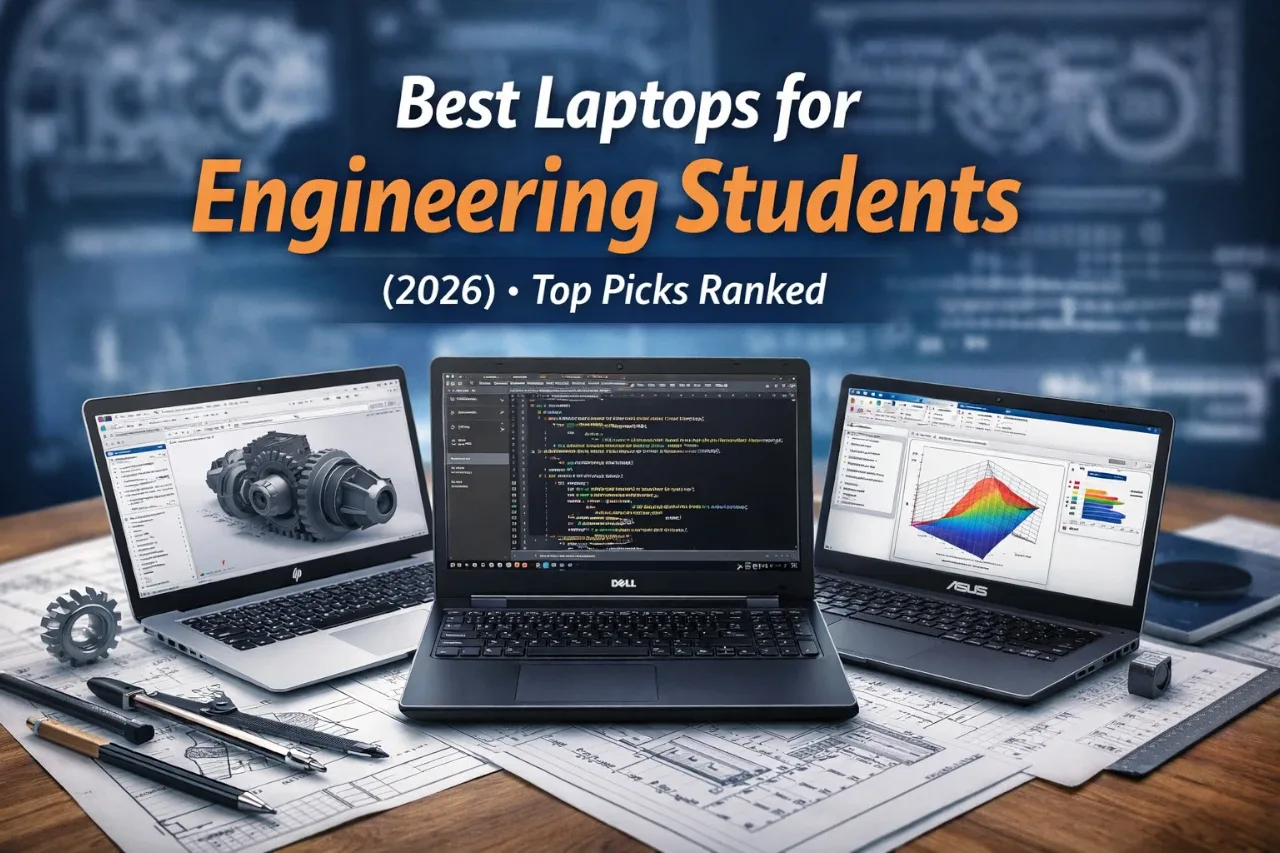
Engineering school workloads are a weird mix: lots of browser tabs and PDFs, coding and MATLAB-like tools, plus occasional CAD or simulation work.
This guide ranks the laptops you listed based on the things that actually matter in that reality: CPU class, RAM/storage headroom, portability, screen usability, ports, and overall value.
Quick Verdict
Best overall: Dell 15 Touchscreen (i7-1355U, 32GB/1TB) — the most balanced “do-everything” option here for engineering students who want strong multitasking at a sane price.
Best value: NIMO N152 (Ryzen 5, 16GB/512GB) — the lowest-cost way to get a capable, modern-feeling laptop for core engineering coursework.
Who should buy from this list: Students doing note-heavy coursework, coding, CAD “light-to-moderate,” and everyday productivity who want 16GB+ RAM and SSD storage.
Who may want to look elsewhere: If you expect heavy 3D CAD assemblies, GPU rendering, or serious simulation work, you’ll likely want a laptop with a dedicated NVIDIA RTX GPU (not represented in this list).
Top Picks at a Glance
| Product | Best for | Key strength | Main drawback |
|---|---|---|---|
| Dell 15 Touchscreen (i7/32GB/1TB) | Most students wanting a safe “one laptop for everything” | Strong multitasking + modern i7 U-series | Integrated graphics limits heavy 3D |
| HP 15.6″ Touch i7 (i7/32GB/1TB) | HP fans who want similar power + lighter chassis | Big RAM/storage + touch | Price is high vs similar Dell |
| ASUS Vivobook 14 (i5/24GB/1TB) | Commuters who want a smaller laptop | Portable + plenty of RAM | 14″ screen can feel tight for CAD |
| NIMO N152 (Ryzen 5/16GB/512GB) | Budget-focused engineering students | Best price-to-usability | 512GB may fill fast with projects |
| Lenovo V15 (Celeron/32GB/1TB) | Basic school + office tasks on a budget | Lots of RAM/storage for cost | CPU is the bottleneck for “engineering” apps |
| jumper Ezbook P1 17.6″ (N95/16GB/640GB) | Big-screen studying on a desk | Huge 17.6″ 16:10 display | Slower CPU class; not great for CAD |
Product Reviews
#1 — Dell 15 Touchscreen (Best Overall)
Why It’s Our Top Pick
For most engineering students, the real win is a laptop that stays fast when you’re juggling: IDE + 20 Chrome tabs + PDFs + Spotify + a second screen. With an i7-1355U paired to 32GB RAM and a 1TB SSD, this Dell configuration is simply the most balanced pick here for the money.
Key Features
- 13th Gen i7-1355U class CPU for strong everyday performance
- 32GB RAM for heavy multitasking and longer useful life
- 1TB SSD for project files + apps without constant cleanup
- Touch + anti-glare FHD screen for notes, diagrams, and docs
What We Like
The big advantage is the 32GB RAM ceiling right out of the box—that’s what keeps the system smooth when your workload gets messy. Port selection is also practical for school life (HDMI + USB-C + SD on this listing), which can reduce dongle pain.
What Could Be Better
This is still an integrated-graphics laptop, so if your program expects serious SolidWorks/Inventor workloads or large assemblies, you may hit a wall. Also, 15.6″ FHD is fine, but not a “premium” creator display.
Pros & Cons
| Pros | Cons |
|---|---|
| Excellent multitasking with 32GB RAM | Not ideal for heavy 3D/GPU workloads |
| 1TB SSD is a true “school-proof” size | FHD panel is functional, not fancy |
| Touchscreen helps with notes and quick sketching | Usually bulkier than 14″ options |
| Good all-around student + work fit |
Who This Product Is Best For
- Engineering students doing coding, office work, lab software, light CAD
- Anyone who keeps tons of apps open and hates slowdowns
- Students who want 1TB storage from day one
Who Should Skip This Product
- Students who know they need an RTX GPU for 3D modeling/rendering
- Anyone who prioritizes ultra-light portability over everything else
#2 — HP 15.6″ FHD Touchscreen i7 (Best “HP Big Spec” Option)

Why It Ranks #2
Spec-for-spec, it’s very similar to the Dell: i7-1355U, 32GB RAM, 1TB SSD. If you strongly prefer HP’s look/feel, or you value the included accessory bundle, it can be a solid pick—just be aware it’s priced high in this listing.
Key Features
- i7-1355U + 32GB RAM for multitasking
- 1TB SSD for projects and apps
- 15.6″ FHD touchscreen
- Wi-Fi 6 + privacy camera shutter
What We Like
This is the kind of configuration that won’t feel “outgrown” quickly. For engineering students, the combination of 32GB RAM + 1TB SSD is genuinely useful over 4 years.
What Could Be Better
The main issue is value: at the listed price, you’re paying a premium for a setup you can often get for less. Also, like the Dell, it’s not meant for heavy 3D work due to integrated graphics.
Pros & Cons
| Pros | Cons |
|---|---|
| Strong multitasking headroom | Expensive for this class of laptop |
| Touchscreen is useful for notes | Integrated graphics limits CAD depth |
| Good storage for long-term use | Battery claims vary a lot in real life |
Best For
- Students who want a high-RAM, high-storage HP laptop
- Heavy browser + coding + office workflows
Skip If
- You want the best price-to-performance (Dell/NIMO often win)
- Your workload requires dedicated graphics
#3 — ASUS Vivobook 14 (Best Portable Pick)

Why It Ranks #3
A 14-inch laptop is often the sweet spot for engineering students who commute, bounce between labs, and carry a bag all day. The i5-1334U is plenty for most coursework, and 24GB RAM + 1TB SSD is an unusually practical combo for the size.
Key Features
- 13th Gen i5-1334U (strong “everyday engineering” CPU tier)
- 24GB RAM to keep multitasking smooth
- 1TB SSD for projects and files
- Compact 14″ FHD design
What We Like
Portability is the real value here. It’s easier to live with daily than a 15.6″ machine, while still having enough memory/storage to behave like a “serious” laptop.
What Could Be Better
The compromise is screen space: 14″ is workable, but CAD and spreadsheets feel tighter. For some students, that means you’ll want an external monitor sooner.
Pros & Cons
| Pros | Cons |
|---|---|
| Great balance of size and power | 14″ can feel cramped for CAD |
| 24GB RAM is very usable | Integrated graphics only |
| 1TB SSD avoids storage stress | Smaller chassis can run warmer under load |
Best For
- Students who carry their laptop daily
- Coding, research, office, light CAD
Skip If
- You want a larger screen for design work without an external monitor
#4 — NIMO N152 (Best Value)

Why It’s the Best Value Pick
At a much lower price point, this laptop hits the baseline engineering students should aim for: 16GB RAM + SSD with a modern Ryzen 5 class CPU. For coursework, coding, and everyday lab software, that can be enough—without overspending.
Key Features
- AMD Ryzen 5 (4-core up to 3.7 GHz per listing)
- 16GB RAM (often the “minimum comfortable” for engineering)
- 512GB SSD with upgrade potential mentioned
- Fingerprint + backlit keyboard for daily usability
What We Like
It’s the most sensible “spend less, still be productive” option. For many students, this is the difference between getting through school comfortably vs. constantly managing slowdowns.
What Could Be Better
512GB can fill faster than you expect if you store lots of project folders, installers, VMs, and media. Also, brand support experience can be more variable versus major OEMs.
Pros & Cons
| Pros | Cons |
|---|---|
| Strong value for core student workloads | 512GB may require upgrades later |
| 16GB RAM is the right baseline | Not a heavy CAD/simulation machine |
| Backlit keyboard + fingerprint are practical | Support ecosystem may be smaller than Dell/HP |
Best For
- Budget-focused engineering students
- Coding, Office, research, light modeling
Skip If
- You want a big-name OEM ecosystem and service options
- You need dedicated graphics
#5 — Lenovo V15 (Buy Only if Your Work Is Mostly Basic)

Why It’s Lower Ranked
This is a classic “spec sheet trap”: it advertises 32GB RAM and 1TB SSD, but the Intel Celeron N4500 class CPU is the limiting factor. Engineering students typically benefit more from a stronger CPU than from oversized RAM on a slow processor.
Key Features
- 15.6″ FHD anti-glare
- 32GB RAM + 1TB SSD
- Numeric keypad + good port variety
- Celeron N4500 (very entry-level)
What We Like
If your tasks are mostly documents, browsing, and video lectures, the RAM/storage can make it feel responsive in light use.
What Could Be Better
For coding projects, engineering apps, or anything computational, the CPU will feel slow sooner. It’s not the machine you want if you’re buying “for engineering” in the practical sense.
Pros & Cons
| Pros | Cons |
|---|---|
| Lots of RAM/storage for the price | CPU is a major bottleneck |
| Anti-glare display is classroom-friendly | Not ideal for engineering software |
| Numeric keypad is useful | Poor long-term performance headroom |
Best For
- Very light coursework + office tasks
- Students who already have access to lab workstations for heavy apps
Skip If
- You need performance for coding, CAD, or analysis tools
#6 — jumper Ezbook P1 17.6″ (Best Big Screen, Not Best for Engineering)

Why It Ranks #6
The standout here is the huge 17.6″ 16:10 display, which is genuinely nice for reading technical PDFs and multitasking without an external monitor. But the Intel N95 tier is not what most people mean by “engineering laptop performance.”
Key Features
- 17.6″ 1920×1200 (16:10) screen
- 16GB DDR5 RAM, 640GB total storage
- USB-C PD support
- Intel N95 class CPU
What We Like
If you live at a desk and want a large screen for study, it’s appealing. The 16:10 aspect ratio is also great for documents and code.
What Could Be Better
Performance will be the limiting factor for engineering software and heavier multitasking. Also, big-screen laptops tend to be less portable in real student life.
Pros & Cons
| Pros | Cons |
|---|---|
| Large 17.6″ 16:10 display is great for studying | CPU class isn’t ideal for engineering workloads |
| 16GB RAM is workable | Less portable and more “desk-first” |
| USB-C PD is convenient | Not suitable for CAD/simulation |
Best For
- Big-screen studying, writing, and basic productivity
- Students who rarely carry their laptop
Skip If
- You need real performance for engineering tools
What to Look for When Buying a Laptop for Engineering Students
1) CPU Tier Matters More Than People Think
Aim for modern Intel Core i5/i7 U-series or better, or Ryzen 5/7 equivalents. Entry-level CPUs (Celeron/N-series) can struggle once you stack real coursework apps.
2) RAM: 16GB Is the Baseline, 32GB Is the Comfort Zone
- 16GB: solid for most students (coding + research + Office)
- 32GB: ideal if you multitask heavily, run VMs, or want maximum longevity
3) Storage: 512GB Minimum, 1TB Is the “No-Regrets” Choice
Engineering projects, installers, and datasets add up fast. If you keep a lot locally, 1TB makes life easier.
4) Graphics: Integrated Is Fine—Until It Isn’t
Integrated graphics handle general school use and light CAD. For serious 3D design, look for an NVIDIA RTX laptop (outside this list).
Final Verdict — The Best Laptop for Engineering Students Here
If you want one safe recommendation from this lineup, the Dell 15 Touchscreen (i7-1355U, 32GB RAM, 1TB SSD) is the best overall blend of performance headroom, storage, and day-to-day usability.
If budget is tight, the NIMO N152 is the best value path to a smooth “engineering student” experience—just accept that it’s not built for heavy CAD and you may eventually want more storage.
| Preview | Product | Price | |
|---|---|---|---|

| Dell 15 Touchscreen for Business Laptop Computer – 15.6″ Anti Glare FHD Display, 13th Gen Intel… | View on Amazon |
FAQ
1) Is 16GB RAM enough for engineering students?
For most coursework, yes. If you run VMs or heavy multitasking, 32GB is safer.
2) Do I need a dedicated GPU for engineering?
Only if you’re doing heavy 3D CAD, rendering, or GPU-accelerated workflows. Many students don’t need it.
3) Is an i7-1355U good for engineering school?
Yes for productivity, coding, and light-to-moderate engineering apps. It’s not a workstation CPU.
4) Should I choose 1TB storage over a faster CPU?
If the CPU is already modern (i5/i7 U-series), 1TB is a big quality-of-life win. Don’t pair huge storage with a weak CPU.
5) Is a 14-inch laptop too small for CAD?
It’s workable, but many students prefer using an external monitor for CAD and large diagrams.
6) Which pick is best for commuting students?
The ASUS Vivobook 14 is the most practical size-performance compromise in this list.
7) Is the Lenovo V15 okay for engineering?
Only if your engineering apps run mostly on lab computers and your laptop is mainly for notes, documents, and browsing.