
Tailulu H14 HEPA Air Purifier — 2200 ft² Clean Air Under $100
Our take: a powerful yet quiet large-room purifier with H14 HEPA, PM2.5 Auto mode and ultra-low 20 dB sleep setting for all-day fresh air.
- H14 HEPA + carbon filter captures 99.99% of smoke, pollen, dust and pet dander.
- Covers up to 2200 ft² with a high-CADR turbine motor for fast whole-room clean air.
- PM2.5 display, Smart Auto mode, 20 dB sleep mode and child lock for set-and-forget use.
- Coverage
- Up to 2200 ft²
- Filter
- 3-stage H14 HEPA
- Noise (Sleep)
- ≈20 dB
- Best For
- Smoke, pets & allergies
Indoor air has quietly become one of the biggest “invisible problems” in modern homes. Between wildfire smoke, traffic pollution, pet dander, cooking fumes and seasonal allergies, many of us are breathing far more than just fresh air inside our own living rooms.
The Tailulu H14 HEPA Air Purifier (model HQKJ-180) is designed as a one-box solution to that problem: a compact tower that promises whole-room coverage up to 2,200 ft², a medical-grade H14 HEPA filter, real-time PM2.5 display, and whisper-quiet 20 dB sleep mode – all at a price that usually hovers around the USD $100 mark.
This review takes a deep, practical look at what the Tailulu H14 actually offers: how it’s built, how it cleans the air, what it’s like to live with day-to-day, where it shines, and where you might run into limitations.
Quick Verdict
If you want a single, affordable air purifier that can realistically cover a large living space, the Tailulu H14 is one of the more aggressive value options right now.
- Best for: families, pet owners, and apartment dwellers who want strong filtration and an automatic “set-it-and-forget-it” mode.
- Stand-out strengths: H14-grade HEPA filter, very generous coverage, real-time PM2.5 display and Auto mode, ultra-quiet sleep mode, child lock, and a full set of timers.
- Main trade-offs: no Wi-Fi/app control, filters need replacing every 3–6 months, and the minimalist design comes in white only.
If smart-home integration doesn’t matter to you and you’d rather have strong filtration plus a simple control panel, this Tailulu offers a lot of performance for the money.
Key Specs and Features
Model: Tailulu HQKJ-180 H14 HEPA Air Purifier
Color: White
Dimensions: 6.7" D × 11.8" W × 15.4" H
Rated Coverage: Up to 2,200 ft² (large rooms / open-plan spaces)
Filtration: 3-stage
- Pre-filter
- H14 True HEPA filter (99.99% of fine particles)
- Activated carbon filter
Core Features:
- Turbine-style motor system with high airflow
- CADR listed around 508 m³/h (in product visuals)
- Real-time PM2.5 display with color air-quality ring
- Smart Auto Mode – automatically adjusts fan speed to pollution level
- Sleep mode at <20 dB with optional night light
- 3 fan speeds (1F / 2F / 3F)
- 5 timers: 2h, 4h, 6h, 8h, 12h
- Child lock to prevent accidental touches
- Filter-replacement reminder (works with HQKJ-180 filters)
- CARB, ETL, EPA, DOE & FCC compliance, ozone-free design
Design & Build Quality
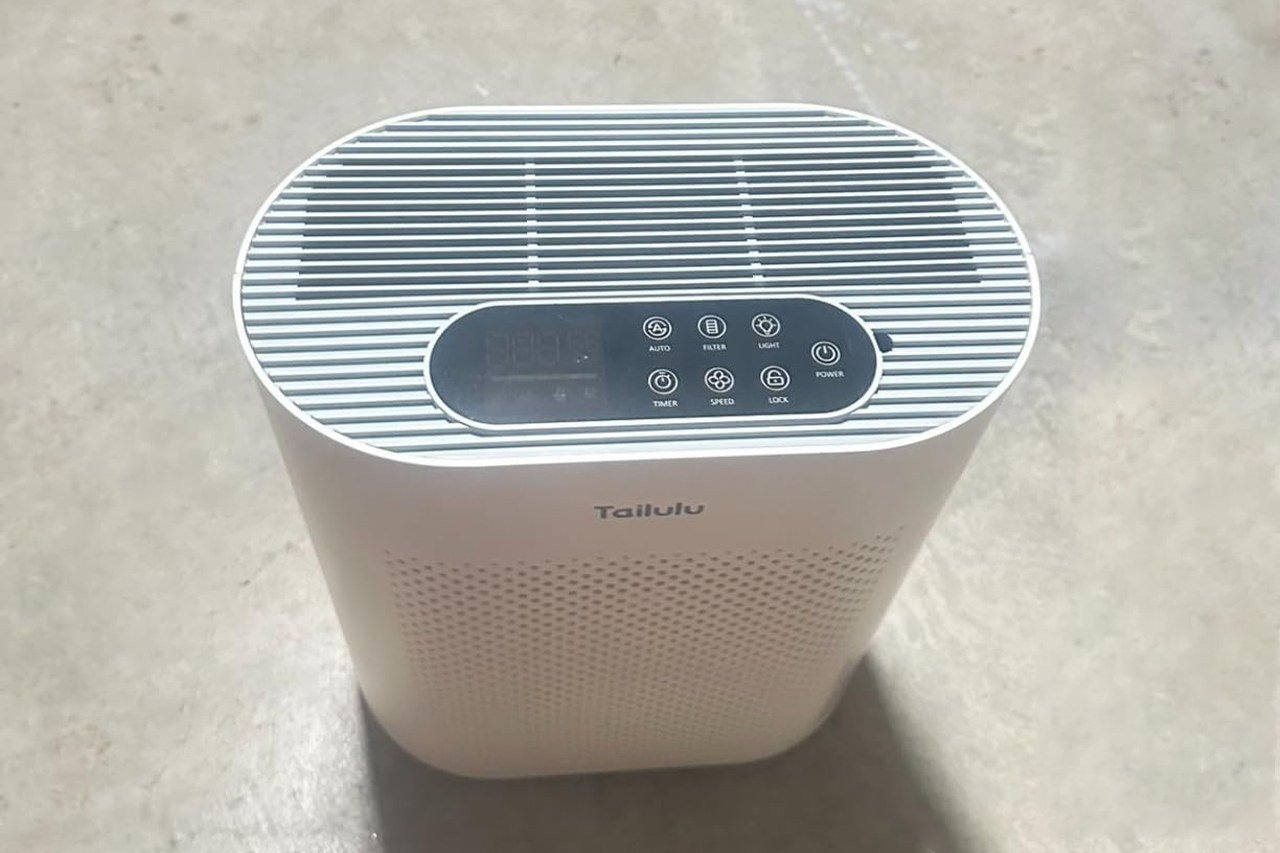
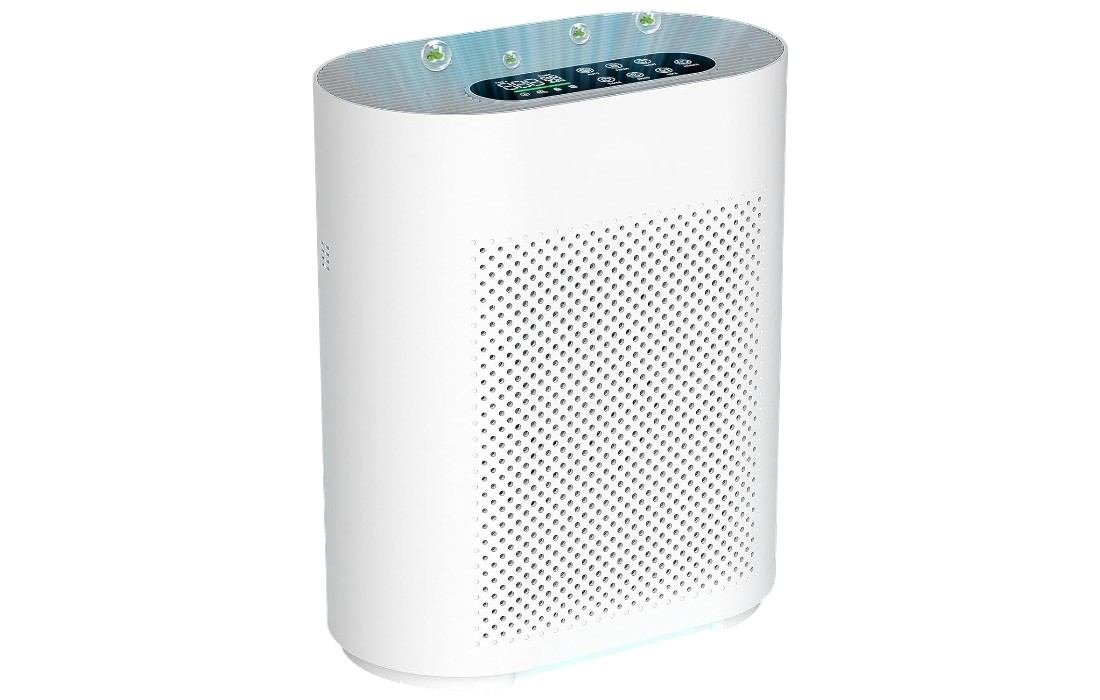
At first glance, the Tailulu H14 looks like something you’d see in a modern apartment catalog: rounded corners, a clean white shell, and a perforated front panel where air is drawn in.
Compact footprint, large-room ambition
Despite the large coverage claim, this purifier is relatively compact:
- The 6.7" depth means it doesn’t stick far out from the wall.
- The 11.8" width and 15.4" height give it more of a small side-table presence than a tall tower.
That’s helpful if you’re short on floor space. You can tuck it near a sofa, beside a TV unit, or close to the bed without dominating the room.
The casing is plastic, as expected at this price, but the overall fit and finish looks neat. The perforated intake panel wraps around the front and sides, helping air enter from a wide angle.
Top control panel and air outlet
All controls live on the top panel, which doubles as the outlet grille. The touch buttons are arranged around a central display that shows:
- PM2.5 numeric value
- Fan speed
- Timer selection
- Child-lock status
- Filter reminder icon
A colored light ring around the body and/or base reflects air quality status (typically green for good, yellow for moderate, red for heavily polluted). This kind of at-a-glance feedback is extremely useful – you don’t have to interpret numbers every time.
The styling is understated enough to blend into most interiors: bedrooms, nurseries, open-plan living rooms, even home offices.
Filtration System – What Does H14 HEPA Actually Mean?
The biggest headline feature on this Tailulu is the H14-grade HEPA filter.
Most budget purifiers use H11–H13 HEPA filters, rated to capture 99.97% of particles ≥0.3 microns. H14 is a stricter classification, typically associated with higher-end or medical-grade filtration, rated to capture 99.99%+ of ultra-fine particles.
3-Stage filtration in practice
The Tailulu H14 uses a classic three-layer cartridge:
- Pre-Filter Layer
- Catches visible “big stuff”: pet hair, fibers, dust bunnies, lint.
- This layer protects the HEPA media so it doesn’t clog too quickly.
- H14 True HEPA Filter
- Targets the fine particulate matter that causes most respiratory issues:
- PM2.5 (fine dust and smog)
- Pollen grains
- Mold spores
- Many bacteria carried in droplets
- This is the core of the system and the main reason allergy sufferers see relief.
- Targets the fine particulate matter that causes most respiratory issues:
- Activated Carbon Matrix
- A dense layer of carbon granules that adsorbs gases and odors:
- Cooking smells
- Pet odors
- Smoke and VOCs (volatile organic compounds)
- A dense layer of carbon granules that adsorbs gases and odors:
In everyday language, this means the Tailulu doesn’t just make the air look cleaner; it can help with smell, smoke, and chemical fumes as well.
For allergies and asthma
If you, your partner, or your kids are sensitive to:
- Spring pollen
- Dust mites
- Pet dander
- Mold spores in an older house or basement
…a high-efficiency HEPA filter is non-negotiable. The H14 rating gives a little extra confidence that even the finer particles are being captured with high probability.
Of course, no purifier can replace medication or medical advice for asthma, but reducing airborne triggers is a big piece of the puzzle.
Coverage, Airflow and Performance
Tailulu advertises this model as suitable for rooms up to 2,200 ft² – which is significantly more than what many sub-$100 purifiers claim. The CADR figure shown in the marketing visuals is around 508 m³/h, which translates to a strong airflow for this size of machine.
To put it in context:
- In a 300–500 ft² bedroom or office, you should get multiple air changes per hour, which is ideal for allergy relief.
- In a mid-sized apartment living room (say 400–700 ft²), it can comfortably handle daily pollutants from cooking, outdoor air coming through windows, and TV-time snacking.
- In a wide open space approaching 2,000+ ft², expect it to still help, but you’ll want to place it intelligently – closer to the main activity area and away from obstacles.
Because it uses a turbine-style motor system, air is drawn in from the front and sides and pushed vertically upwards. This top-exhaust design helps circulate clean air throughout the room without blowing directly on you.
If you’re dealing specifically with:
- Wildfire smoke during certain months
- An urban environment next to busy roads
- A home with multiple pets shedding hair and dander
…this combination of high airflow and H14 filtration is exactly what you want.
PM2.5 Sensor and Smart Auto Mode
One of the standout “smart” features of the Tailulu H14 is its built-in PM2.5 sensor and real-time display. Instead of just guessing when the air is bad, you can see a number on the panel and watch it shift as conditions change.
How it works
- A sensor continuously samples room air and estimates the concentration of fine particles (PM2.5).
- The display shows this value along with an air-quality color band:
- Green: generally clean
- Yellow / Orange: moderate pollution
- Red: high pollution (cooking, smoking, outdoor haze, etc.)
When you switch on Auto Mode, the purifier takes control of the fan:
- At low PM2.5 levels, it runs quietly on a lower speed to save power.
- When the sensor detects a spike – for example frying food, spraying aerosols, or someone smoking nearby – it ramps up to higher fan speeds automatically.
The effect is that you can leave the Tailulu running in the background all day, and it will respond dynamically instead of running at full blast unnecessarily.
This is especially useful for:
- People who forget to adjust settings manually.
- Households where air quality changes quickly (open windows, heavy cooking, pets coming in and out).
- Anyone trying to balance clean air with electricity costs.
Controls, Fan Speeds and Timers
Even though there’s no app, the physical controls cover most day-to-day needs.
Fan modes
You get three main fan speeds:
- 1F (Low): quiet background purification, good for bedrooms or continuous day use.
- 2F (Medium): balanced noise and performance for typical living areas.
- 3F (High): maximum airflow for quick clean-up after cooking, cleaning, or a smoky event.
In addition, Sleep Mode is essentially an extra-quiet variant of low speed with all non-essential lights dimmed.
Timers
The Tailulu offers five timer presets:
- 2 hours
- 4 hours
- 6 hours
- 8 hours
- 12 hours
This makes it easy to:
- Run it only during your evening routine and let it switch off after you go to sleep.
- Schedule it for a full workday in a home office (8h).
- Set a deep clean cycle for a half-day after guests leave or after heavy cooking.
Because these are hardware timers, you don’t have to rely on a smartphone or Wi-Fi to automate basic operation.
Child lock
If you have curious kids (or adventurous cats) who love pressing buttons, the child-lock function is essential. A long press on the lock icon freezes the current settings so that random taps won’t change the fan speed or power state.
Sleep Mode & Night Light – Bedroom Friendliness
Noise level is one of the most common reasons people abandon air purifiers in the bedroom. Tailulu tackles this directly with a sleep mode rated at under 20 dB – quieter than a whisper and comparable to the sound of rustling leaves.
What sleep mode does
- Drops the fan to a very low, steady speed.
- Dims or turns off most indicator lights.
- Keeps the optional night light at a soft glow (or you can switch it off entirely).
For light sleepers, white-noise fans in the 30–40 dB range can still be noticeable. A purifier that can run below 20 dB is effectively blending into the background.
The night light is positioned at the base of the unit, casting a gentle halo rather than a bright beam. It’s handy if you:
- Get up at night and don’t want to turn on the main lights.
- Have kids who feel safer with a low light in the room.
Because you can control the night light independently, it won’t annoy you if you prefer a completely dark bedroom.
| Preview | Product | Price | |
|---|---|---|---|

| air purifier | $89.99 | View on Amazon |
Real-World Use Cases
Let’s look at how the Tailulu H14 fits into common scenarios.
1. For allergy sufferers
If you live with seasonal allergies, dust sensitivity or mild asthma, the combination of H14 HEPA filtration and Auto mode is particularly attractive:
- The pre-filter and HEPA layers strip out pollen grains, dust mites and pet dander from the air relatively quickly.
- When you open windows during high-pollen days, the PM2.5 sensor will pick up the increase and bump the fan up automatically.
Placing the purifier in the bedroom or main living area and letting it run continuously during allergy season can often reduce sneezing, itchy eyes and morning congestion – assuming, of course, that you’re also washing bedding regularly and vacuuming with a HEPA vacuum.
2. For pet owners
Dogs and cats are adorable, but their hair and dander are not. With pets, you’re fighting:
- Floating hair and fur
- Dander particles
- Litter-box odors (for cats)
- Wet dog smell after baths or rainy walks
The Tailulu’s pre-filter traps hair and larger debris, while the HEPA and carbon layers handle the smaller particles and smells. Put it in the same room as the pet bed or litter box, and let Auto Mode respond to spikes in odor or dust when you’re cleaning or the pet is particularly active.
3. Cooking, smoke and VOCs
Cooking creates a surprising amount of particulate matter and grease, especially if you fry or sear food frequently. And if someone smokes indoors – or you’re in an area affected by wildfire smoke – the problem intensifies.
The activated carbon in the Tailulu is specifically there to help with:
- Kitchen odors (onions, garlic, fish, oil)
- Smoke from outdoor fires that drifts in through windows
- Cigarette smoke (though never as effective as banning smoking indoors)
- Residual VOCs from cleaning sprays, paints or new furniture
Placing the purifier between the kitchen and living room gives it a chance to intercept and neutralize odors before they linger in fabrics and curtains.
4. Basements, dorm rooms and rentals
Basements and older apartments often have:
- Stale air
- Slight damp or musty odors
- Limited ventilation
The Tailulu’s strong airflow and carbon filter can freshen these spaces significantly, and the quiet operation means you can run it continuously without feeling like you’re living next to a loud fan.
In a dorm room, the combination of small footprint, night-light, child lock and low noise makes it student-friendly. It helps cut down on shared-space smells, dust from old buildings, and airborne pathogens circulating through common hallways.
Maintenance and Filter Costs
Any HEPA purifier lives or dies by its filter maintenance. A neglected filter becomes a clogged filter – and eventually, a useless one.
Filter replacement schedule
Tailulu recommends changing the HQKJ-180 filter every 3–6 months, depending on pollution levels and usage time. A built-in indicator light comes on when the system estimates the filter is reaching its limit; after you replace the cartridge, you reset it by holding the button for a few seconds.
In a heavily polluted city, or if you run the unit 24/7, expect to land closer to the 3-month mark. In a cleaner suburban home running mainly in the evenings, you may comfortably stretch towards 6 months.
Cost of replacement filters
Official HQKJ-180 replacement filters are sold separately. Tailulu’s other HEPA filter cartridges typically sit in the roughly $30–$40 price range depending on promotions and pack size, which is a reasonable ballpark to expect here as well.
If you replace the filter twice a year, your ongoing cost might be around $60–$80 per year, which is fairly standard for this class of purifier.
Day-to-day upkeep
To keep the system efficient between full filter swaps:
- Vacuum the pre-filter gently every few weeks to remove hair and lint.
- Ensure the air intake and outlet are not blocked by furniture or curtains.
- Wipe the exterior with a soft cloth if dust builds up.
These small habits extend the life of the HEPA media and keep the airflow strong.
Energy Use and Operating Costs
While Tailulu doesn’t prominently publish exact wattage on all product pages, similar large-room HEPA purifiers in this category typically draw between 30–60 watts on mid-to-high settings and significantly less in sleep mode.
Thanks to Auto Mode and low-power sleep mode, you’re not forced to run the purifier at full throttle around the clock. If it spends most of its time at lower speeds and only occasionally ramps up to high, your monthly electricity cost is likely to be modest – usually comparable to or less than running a single light bulb all day.
From an energy-awareness perspective:
- Sleep Mode is ideal for overnight use.
- Auto Mode ensures the purifier only uses extra power when pollution levels justify it.
In addition, the marketing material mentions Energy Star-level efficiency, which indicates that the device has been designed with energy use in mind.
Safety and Certifications
Air purifiers are supposed to improve health, not introduce new risks. The Tailulu H14 is advertised as:
- CARB compliant – the California Air Resources Board has strict rules about ozone emissions from air cleaning devices; CARB compliance means it meets those limits.
- ETL, EPA, DOE and FCC certified – covering electrical safety, energy efficiency and electromagnetic compatibility.
Importantly, this purifier does not use UV-C lamps or ionizers that generate ozone, making it a safer choice for families with kids, pets, or anyone with respiratory sensitivities.
What’s Missing? (Limitations & Trade-offs)
No product is perfect, and it’s easier to decide if this purifier fits your home once you know where it falls short.
1. No Wi-Fi or app control
Some newer purifiers offer:
- Smartphone apps
- Historical air-quality graphs
- Scheduling via Wi-Fi
- Voice control through Alexa or Google Assistant
The Tailulu H14 skips all of that. Everything is controlled from the top panel. For many people that’s actually a plus – less setup, fewer things to go wrong – but if you’re deep into smart-home automation, you might miss app support.
2. Filter cost over time
While the annual filter cost is reasonable for a large-room HEPA purifier, it’s still an ongoing expense you should factor in. If you run the purifier 24/7 in a polluted area, filters may need replacing closer to every 3–4 months, increasing yearly cost.
3. Single color and minimalist look
Currently this model is offered in white only. The minimalist, appliance-like look is easy to blend into neutral interiors but may stand out more in darker or very warm-toned rooms.
4. No dedicated formaldehyde or advanced gas module
The basic activated-carbon layer is good for everyday odors and general VOCs, but if you’re specifically worried about heavy chemical exposure or renovation off-gassing, a more specialized purifier with larger or targeted gas filters might be worth considering.
Who Is the Tailulu H14 Best For?
Choose this purifier if:
- You need strong filtration for a large area – an open-plan living room, a small apartment, or a large bedroom.
- You want medical-grade H14 HEPA without paying premium brand prices.
- Real-time PM2.5 monitoring and automatic adjustment appeal to you.
- Noise sensitivity is an issue and you need a very quiet sleep mode.
- You prefer physical controls and don’t care about Wi-Fi or apps.
- There are kids or pets in the home and you value the child-lock feature.
Look elsewhere if:
- You specifically want app control, voice control, or smart-home integration.
- You’re willing to pay extra for ultra-premium features like separate chemical cartridges, formaldehyde sensors, or medical-lab-grade performance data.
- Your main use case is a very small room under ~150 ft² and you’d rather buy a cheaper, ultra-compact unit instead.
Pros & Cons
Pros:
- H14 True HEPA filter for very high efficiency on fine particles
- Generous coverage up to 2,200 ft² with strong airflow
- PM2.5 sensor and real-time display make air quality visible
- Smart Auto Mode automatically adapts fan speed to pollution levels
- Extremely quiet sleep mode (<20 dB) – excellent for bedrooms and nurseries
- Soft night light with the option to turn it off
- 5 timer options plus three main fan speeds for flexible control
- Child lock to prevent accidental changes
- Filter reminder so you don’t forget maintenance
- Ozone-free design and multiple safety/energy certifications
- Very competitive pricing for the feature set
Cons:
- No Wi-Fi, app, or voice control – all adjustments must be made on-device
- Ongoing filter costs (typically every 3–6 months) add to total ownership cost
- Only available in white, which may not suit all décor styles
- Basic carbon filter, not a specialized heavy-duty gas filter
- As with any purifier, you still need good cleaning habits (vacuuming, dusting) for best results
Final Thoughts – Is the Tailulu H14 HEPA Air Purifier Worth It?
When you step back and look at the Tailulu H14 HEPA Air Purifier as a whole, a clear picture emerges:
- It focuses heavily on core performance – strong airflow, H14 HEPA media, and effective odor control via activated carbon.
- It adds a genuinely useful PM2.5 sensor and intuitive Auto Mode, so you don’t have to micromanage it.
- It’s designed to disappear into daily life: quiet at night, simple to operate, safe for kids and pets, and unobtrusive in most rooms.
You do trade away fancy app integration and deep smart-home features. But for many households, those are “nice to have” extras rather than essentials. What matters most is that the air actually gets cleaned – and on that front, the Tailulu H14 does a lot of things right for the price.
If your main goal is to tame dust, pet dander, smoke and seasonal allergies across a large room or small apartment, and you want a purifier that can run quietly in the background without constant attention, the Tailulu H14 HEPA Air Purifier is a very strong candidate to put on your shortlist.
Breathe Cleaner Air in Every Room
Tailulu H14 HEPA scrubs smoke, dust and pet dander from up to 2200 ft²—so your family can finally breathe easy.