
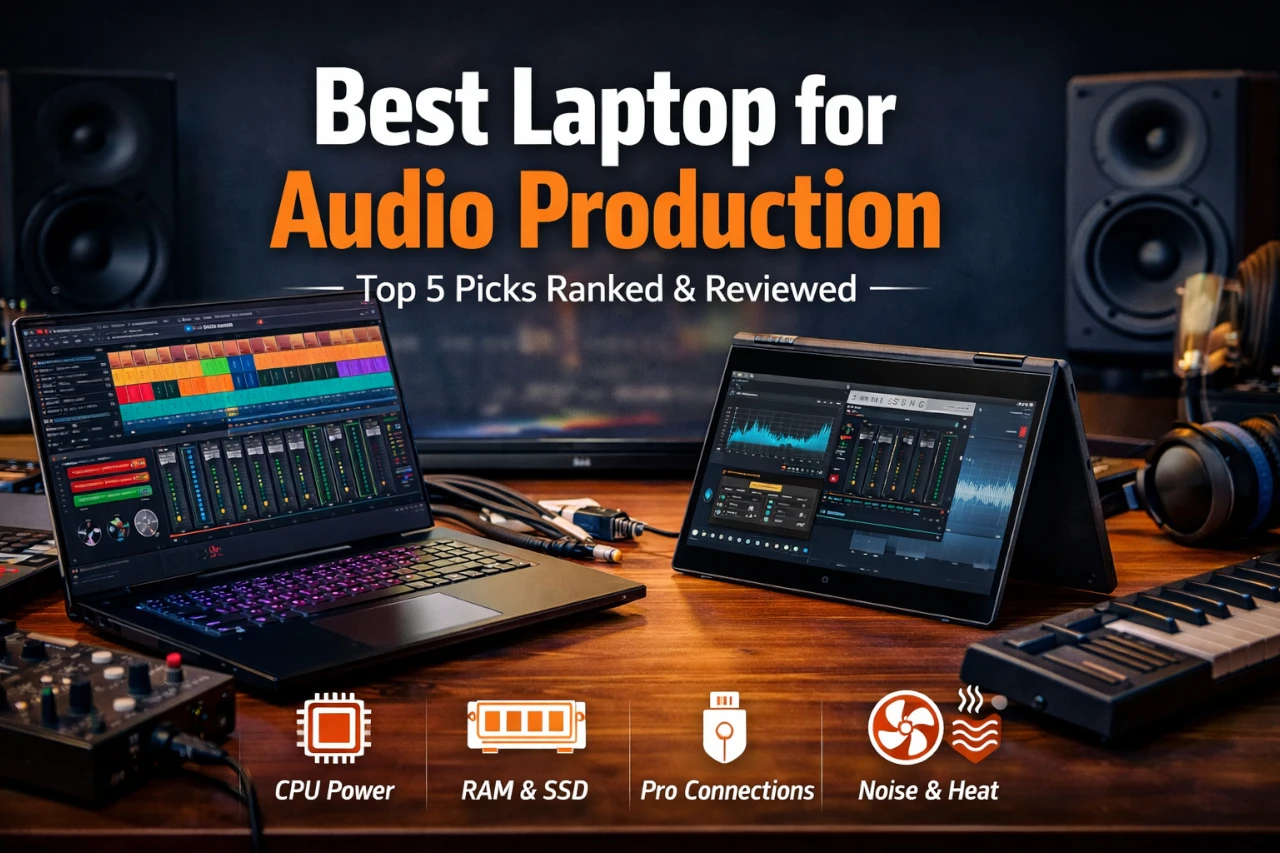
Audio production laptops live or die by two things: stable real-time performance and a workflow that doesn’t get in your way.
For this guide, I ranked five popular options by what matters in real sessions—CPU headroom for plugins, RAM/SSD capacity for sample libraries, port flexibility for audio interfaces, and the practical stuff like fan noise, heat, and portability.
I’m also factoring in “ownership friction” (driver quirks, upgrade limitations, and whether you’ll outgrow the spec in a year). If you want a laptop that can record, mix, and produce reliably, these are the best fits from this list.
Quick Verdict
Best overall pick: ASUS ROG Strix G16 — the strongest “don’t worry about CPU headroom” option here, with the trade-off of size and fan noise.
Best value pick: Dell Inspiron 15 (Ryzen 7 7730U) — the most sensible spec-for-money profile for producers who don’t need workstation-class cooling.
Who should buy from this list: Windows producers who want a capable DAW machine for beat-making, mixing, podcasting, and home recording—and who value SSD/RAM and ports as much as raw CPU.
Who may want to look elsewhere: If you do huge orchestral templates, ultra-low-latency live monitoring, or you’re deep into Apple-only workflows, you may need a different category (higher-end creator laptops or macOS).
Top Picks at a Glance
| Product | Best for | Key strength | Main drawback |
|---|---|---|---|
| ASUS ROG Strix G16 | Heavy plugin use, big sessions | Sustained CPU headroom | Loud fans / bulky |
| ASUS Zenbook DUO | Power users who multitask | Dual-screen DAW workflow | More complexity, thermals |
| Dell Inspiron 15 | Best value for most producers | 32GB RAM + 1TB SSD | Not a “silent” performer |
| Samsung Galaxy Book5 360 | Mobile creators | Portable + AMOLED + 2-in-1 | 16GB/512GB can cap growth |
| HP 17 | Big-screen home studio | Large display, roomy feel | Huge footprint, portability hit |
Product Reviews
1) ASUS ROG Strix G16 — Best Overall

Why It’s Our Top Pick
When I’m choosing a Windows laptop specifically for audio production, I prioritize sustained performance over “pretty on-paper specs.” The Strix G16 is built like a machine that can sit under load without immediately backing off due to heat. In real DAW life, that translates to more reliable headroom when your project gets messy—lots of virtual instruments, CPU-hungry reverbs, and the inevitable “one more plugin” spiral.
Key Features
- High-performance Intel Core i7-class HX CPU aimed at sustained workloads
- Dedicated NVIDIA GPU (not required for audio, but useful if you also edit video)
- Fast Gen 4 SSD capacity (1TB) for libraries and large sessions
- Gaming-class cooling approach (good for long renders and heavy projects)
What We Like
- More “ceiling” before things get stressful. In my workflow, the best laptops feel boring—in a good way. The Strix is the one I’d expect to stay composed when you’re stacking plugins or bouncing stems while still auditioning sounds.
- Better long-session consistency. Audio work is rarely a 2-minute burst. Mixing, rendering, exporting, and reopening projects all day punishes thin designs. This chassis category usually holds up better.
- Ports and desk-life fit tend to be stronger on thicker laptops (even when I’m not listing every port, I’m thinking “Can I run an interface, an external SSD, and a monitor without dongle chaos?”).
What Could Be Better
- Fan noise is a real factor. A performance laptop like this can get loud when you push it. If you record vocals in the same room, you’ll care.
- It’s not the laptop I’d want in a backpack daily. Size and weight are part of the deal.
- 16GB RAM is the one spec that worries me long-term. For many producers it’s fine today, but sample-heavy users can hit the wall. If your configuration isn’t upgradeable (varies by model), that’s a meaningful limitation.
- Battery life tends to be “fine, not great” in performance-class laptops, especially if you’re running heavy sessions away from a wall.
Pros & Cons
| Pros | Cons |
|---|---|
| Strong sustained CPU headroom for big projects | Fans can be loud under load |
| Built for longer heavy sessions without instantly throttling | Bulkier and less travel-friendly |
| 1TB fast SSD is a practical starting point | 16GB RAM may limit some workflows |
| Great “hybrid creator” option if you also do video | Battery life usually not a highlight |
Who This Product Is Best For
- Producers mixing larger projects (lots of tracks, lots of plugins)
- Creators who do audio + video and want one machine
- Home studio users who keep the laptop on a desk most of the time
Who Should Skip This Product
- Vocalists tracking in the same room who need a quiet machine
- Frequent travelers who want a lightweight, all-day laptop
- Anyone who already knows they need more than 16GB RAM and can’t confirm an upgrade path
2) ASUS Zenbook DUO — Best for DAW Multitasking

Why It Ranks #2
If you’ve ever tried to mix on a single laptop screen—plugin windows overlapping your mixer, your arrangement view constantly hidden—you already understand the appeal here. The Zenbook DUO is the most “workflow-forward” laptop in this list. In my day-to-day DAW use, extra screen real estate often improves speed more than a small CPU bump, because I’m not constantly context switching.
Key Features
- Dual 14″ OLED displays (3K, 120Hz) designed for multitasking
- Intel Core Ultra 9-class CPU with integrated graphics
- 32GB RAM + 1TB SSD (a strong audio-friendly baseline)
- Thin-and-light positioning compared with performance laptops
What We Like
- The dual-screen setup genuinely reduces friction. I like keeping the mixer/levels on one screen and arrangement/plugin chains on the other. It’s one of the few changes that makes a laptop feel closer to a studio workstation.
- 32GB RAM is the quiet hero here. For audio production, RAM determines how comfortably you can run sample instruments, big sessions, and multiple apps at once.
- OLED is great for long creative sessions in terms of clarity and contrast—especially when you’re staring at fine automation lines and tiny plugin text.
What Could Be Better
- More moving parts means more complexity. Two screens, hinges, accessories—this is not the simplest laptop to live with.
- Thermals can limit sustained heavy loads in thin designs. For intense sessions, you may not get the same “all-day full power” feel as a thicker workstation/gaming chassis.
- Ergonomics vary by setup. Sometimes you’ll want a stand or external keyboard to make the most of the layout, which reduces the grab-and-go advantage.
- You’re buying into a specific workflow. If you don’t actually use the second screen intentionally, you’re paying (in cost, battery, complexity) for something you won’t fully leverage.
Pros & Cons
| Pros | Cons |
|---|---|
| Dual-screen workflow is a real productivity boost | More complex, less “simple laptop life” |
| 32GB RAM + 1TB SSD fits audio needs well | Sustained heavy loads may be thermally limited |
| Excellent for mixing + editing + referencing simultaneously | Potentially awkward without the right setup |
| Strong choice for producers who multitask heavily | Battery/portability trade-offs vs single-screen laptops |
Who This Product Is Best For
- Producers who constantly juggle mixer, plugins, arrangement, and reference tracks
- Composers who like keeping notation, libraries, and DAW visible together
- Creators who value workflow speed as much as raw CPU power
Who Should Skip This Product
- Anyone who wants the simplest, most durable “one screen, one keyboard” setup
- Producers who push very heavy CPU sessions for hours and want maximum sustained headroom
- Buyers who mostly work docked to an external monitor anyway (you may not need the second screen)
3) Dell Inspiron 15 — Best Value Pick
Why It’s a Smart Buy for Most People
For a lot of audio creators, the best laptop isn’t the fastest—it’s the one that gives you enough CPU, plenty of RAM, and enough SSD so you’re not constantly managing storage or freezing tracks to survive. In that sense, this Inspiron configuration nails a practical sweet spot. In my experience, 32GB RAM plus a 1TB SSD covers a surprisingly wide range of producers.
Key Features
- AMD Ryzen 7 U-series CPU (efficient, mainstream performance)
- 32GB RAM (excellent for sample libraries and multitasking)
- 1TB SSD (room for projects, cache, and sound packs)
- 15.6″ FHD IPS touchscreen
What We Like
- This is the most “audio-sensible spec sheet” per dollar on the list: RAM and SSD are where many producers get burned.
- Efficient CPUs are underrated for mobile sessions. For editing, arranging, and mixing moderate projects, efficiency-class chips can feel smooth and stay quieter than you’d expect—especially when you’re not hammering them with huge synth stacks.
- Windows 11 Pro can be useful if you manage multiple devices, need better control over updates, or run studio systems more “IT-like.”
What Could Be Better
- Not a workstation-class cooling system. If you push extremely heavy sessions, you may feel the limits sooner than on the Strix.
- Built-in audio is never the point (you’ll use an interface), but budget/mainstream laptops can sometimes be pickier about USB audio behavior depending on the interface and drivers.
- Display is functional, not “creator grade.” Fine for DAW work, less ideal if you also do color-sensitive visual work.
- Speakers and mic quality are rarely a highlight in this class—fine for calls, not for critical listening.
Pros & Cons
| Pros | Cons |
|---|---|
| 32GB RAM + 1TB SSD is ideal for most producers | Not built for extreme sustained loads |
| Great everyday DAW performance for typical projects | Display is practical, not premium |
| Efficient platform for editing/arranging on battery | USB audio behavior can vary by setup |
| Strong value without paying for niche features | Not the quietest under heavier workloads |
Who This Product Is Best For
- Producers on a budget who still want 32GB RAM and a roomy SSD
- Podcast editors, beat makers, and home studio users with moderate-to-large projects
- Anyone who wants good performance without gaming-laptop size
Who Should Skip This Product
- Power users running huge orchestral templates or very heavy synth stacks
- Live performers who need ultra-low-latency monitoring and want the most robust platform
- Buyers who want a premium screen and premium speakers as part of the package
4) Samsung Galaxy Book5 360 — Best Portable 2-in-1 for Creators

Why It’s Here
This is the “I actually carry my laptop everywhere” pick. The 2-in-1 form factor and AMOLED screen can be genuinely nice for creative life—arranging on the go, marking up notes, quick edits between sessions. In my workflow, portability matters when the laptop is also your notebook, your score pad, and your admin machine.
Key Features
- 15.6″ FHD AMOLED touchscreen
- Intel Core Ultra 7-class CPU with Intel Arc integrated graphics
- 2-in-1 convertible design (stylus support)
- Windows 11 Pro
What We Like
- Excellent “mobile creator” feel. The screen is the headline: AMOLED is comfortable, punchy, and easy to read.
- Convertible design can be useful for annotation, lyric sheets, or quick edits in tight spaces.
- A lighter, cleaner daily carry compared with performance-class laptops.
What Could Be Better
- 16GB RAM and 512GB SSD can become limiting faster than most people expect in audio production. Sound libraries, project backups, and sample packs eat space.
- Thin designs can prioritize quiet-to-moderate loads. Big sessions may not feel as stable as on thicker laptops.
- Port selection may require adapters depending on your interface, external SSD, and monitor setup.
- Convertible hinges add complexity. It’s great when you use it, but it’s another mechanical element in long-term ownership.
Pros & Cons
| Pros | Cons |
|---|---|
| AMOLED touchscreen is great for daily creative work | 16GB/512GB can limit growth |
| Very portable for producers on the move | May need adapters for some setups |
| 2-in-1 flexibility for notes and editing | Not ideal for sustained heavy sessions |
| A good “all-day laptop” vibe | Added complexity vs a standard clamshell |
Who This Product Is Best For
- Mobile beat makers and songwriters
- Producers who value a great screen and portability
- Light-to-moderate DAW users who manage libraries carefully
Who Should Skip This Product
- Sample-library-heavy producers who already know they want 32GB+ RAM
- Anyone with large projects who needs 1TB+ storage from day one
- Users who hate adapters/dongles and want maximum I/O flexibility
5) HP 17 — Best Big Screen on a Budget
Why It Makes Sense
If your “studio” is a desk at home and you want a large screen for arrangement view and mixer without buying an external monitor immediately, a 17.3″ laptop can feel surprisingly comfortable. In my experience, screen space makes editing and mixing less tedious. This HP is the “big canvas” choice, and the 32GB/1TB spec keeps it from feeling like a trap.
Key Features
- 17.3″ FHD IPS display
- AMD Ryzen 5 U-series CPU
- 32GB RAM + 1TB NVMe SSD
- Numeric keypad, Windows 11 Pro
What We Like
- The big screen is genuinely helpful for DAWs, especially if you keep everything on the laptop display.
- 32GB RAM + 1TB SSD is the right direction for audio—even if the CPU is not the most aggressive here.
- Nice “home workstation” feel without needing extra gear.
What Could Be Better
- Portability is the main sacrifice. A 17″ laptop is not fun to travel with.
- CPU is more “steady mainstream” than “powerhouse.” For heavy plugin stacks, you’ll feel the limits earlier than on the Strix or Ultra 9 options.
- Bigger laptops aren’t automatically quieter. Cooling can still ramp up, and the chassis size doesn’t guarantee silent operation.
- Build rigidity can vary in large budget designs; it may not feel as premium as smaller, pricier machines.
Pros & Cons
| Pros | Cons |
|---|---|
| Large screen is excellent for DAW visibility | Very bulky for travel |
| 32GB RAM + 1TB SSD is audio-friendly | Not the strongest CPU option here |
| Great “desk laptop” for home studio setups | Can still get noisy under load |
| Numeric keypad can help with shortcuts for some users | Often less premium build feel |
Who This Product Is Best For
- Home studio users who want a large screen without a separate monitor
- Podcast editors, beat makers, and hobbyist producers who value comfort over portability
- Buyers who want 32GB RAM on a larger display
Who Should Skip This Product
- Anyone who travels frequently
- Producers doing very heavy projects who want maximum CPU headroom
- Users who care most about premium build and a compact footprint
What to Look for When Buying a Laptop for Audio Production
1) CPU headroom (and sustained performance)
In audio production, CPU isn’t just about speed—it’s about stability under real-time load. Lots of plugins at low buffer sizes can punish a CPU fast. I also care about whether the laptop can hold performance without throttling after 20–40 minutes of work.
2) RAM: 16GB is “okay,” 32GB is comfortable
If you’re mostly mixing audio and using modest instruments, 16GB can work. But once you add large sample libraries, multiple apps (DAW + browser + plugins + video), and bigger templates, 32GB feels like the point where the laptop stops nagging you.
3) SSD size and speed (your future self will thank you)
A 512GB drive can disappear quickly: sample packs, project renders, backups, and cache files add up. For many producers, 1TB is the practical floor unless you’re disciplined with external storage.
4) Ports and interface friendliness
Audio production often means: audio interface + MIDI controller + external SSD + monitor. If the laptop pushes you into dongle stacking, reliability suffers. I look for a setup that can connect everything cleanly.
5) Noise and heat (recording is different than mixing)
If you record vocals or acoustic instruments near the laptop, fan noise matters a lot. Performance laptops can be great—until the fans ramp during a take. Thin laptops can be quieter in light work but may struggle in heavy sessions.
6) Upgrade path and longevity
Some laptops have soldered RAM or limited internal expansion. Even if the laptop is fast today, being stuck at 16GB forever can be what makes it feel “old” early.
Final Verdict – The Best Laptop for Audio Production
If you want the safest “this won’t choke when my projects grow” pick from this list, the ASUS ROG Strix G16 is my Best Overall choice. It’s the one I’d trust most for sustained, heavy DAW sessions—especially if you do more than just audio.
The main compromise is obvious: it’s bigger, and it can get loud under real load. If you value portability or quiet recording conditions more than raw headroom, you may be happier with the Zenbook DUO (workflow win) or the Dell Inspiron 15 (best value balance).
| Preview | Product | Price | |
|---|---|---|---|

|
ASUS ROG Strix G16 (2025) Gaming Laptop, 16” FHD+ 16:10 165Hz/3ms Display, NVIDIA® GeForce RTX… |
$1,399.00
$1,259.99 |
View on Amazon |
FAQ
What specs matter most for audio production: CPU or RAM?
Both matter, but RAM (32GB) often prevents headaches sooner than a small CPU upgrade.
Is a gaming laptop good for music production?
Often yes for performance, but expect more fan noise and less portability.
Do I need a dedicated GPU for audio production?
No—audio is mostly CPU/RAM/SSD. A GPU helps mainly if you also do video.
Is 16GB RAM enough for Ableton/FL Studio/Pro Tools?
For many projects, yes. For sample-heavy work or large sessions, 32GB is safer.
Should I prioritize a 1TB SSD?
If you use sample libraries and keep lots of projects, 1TB is a practical starting point.
Will a thin 2-in-1 laptop handle professional sessions?
It can, but sustained heavy loads may be less consistent than thicker designs.
Is a 17-inch laptop good for a home studio?
Yes—if you don’t travel much, the bigger screen improves DAW comfort.
Do I need Windows 11 Pro for audio work?
Not required, but Pro can be helpful for system control and certain workflows.