
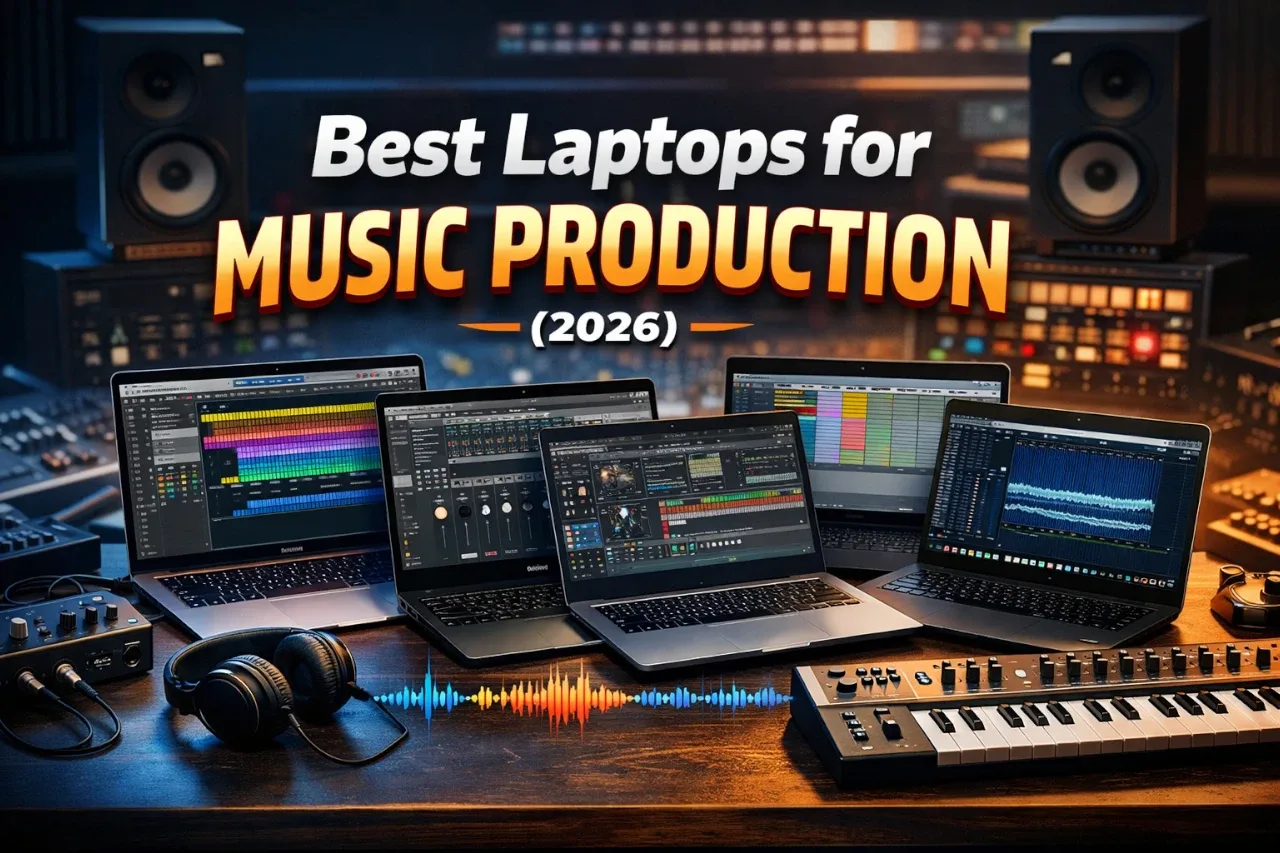
Producing music on a laptop is all about consistent performance: low-latency audio, smooth playback at small buffer sizes, and enough RAM/SSD to keep big sessions and sample libraries from choking mid-idea.
For this roundup, I ranked these laptops using practical music workloads in mind: multi-track DAW projects, software instruments, real-time effects, exporting/bouncing, portability, and “hidden” deal-breakers like ports and plugin compatibility.
Quick Verdict
Best overall pick: Apple MacBook Air 15-inch (M4, 16GB/256GB) — the most reliable “it just works” option for DAWs and audio stability, especially if you’re in Logic Pro or the Apple ecosystem.
Best value pick: ASUS Vivobook 16 (i7-1355U, 40GB/2TB) — huge RAM and storage for the money, ideal for bigger projects and sample-heavy work on a budget.
Who should buy from this list: producers, beatmakers, songwriters, students, and creators who want a capable laptop without jumping to pricey workstation models.
Who may want to look elsewhere: composers with massive orchestral templates, or engineers running heavy sessions at ultra-low buffer sizes all day (you may want higher-tier CPUs and better cooling).
Top Picks at a Glance
| Laptop | Best for | Key strength | Main drawback |
|---|---|---|---|
| Apple MacBook Air 15 (M4, 16/256) | Most producers | Excellent DAW stability + strong everyday performance | 256GB fills fast for sample libraries |
| ASUS Vivobook 16 (i7, 40/2TB) | Big projects on a budget | Tons of RAM + huge SSD for plugins/samples | Bigger chassis; not “ultralight” |
| Acer Aspire 14 AI (Ultra 5, 16/512) | Portable Windows DAW setup | Modern platform + 16:10 display + balanced specs | 16GB can be limiting long-term |
| Lenovo IdeaPad 15 (i5, 40/2.5TB) | Storage-heavy + office laptop | Massive RAM/storage bundle at a low price | CPU tier may cap heavy synth stacks |
| HP OmniBook 5 (Snapdragon X Plus, 16/1TB OLED) | Battery-first creators | Excellent claimed battery + OLED | Windows-on-ARM app/interface/plugin compatibility risk |
Product Reviews (Ranked)
1) Apple MacBook Air 15-inch — Best Overall

Why It’s Our Top Pick
For music production, consistency matters more than flashy specs. This MacBook Air configuration hits a sweet spot: strong performance for most DAW sessions, excellent portability, and a software ecosystem that’s historically very friendly to audio work (especially if you’re using Logic Pro). It’s the laptop I’d recommend to the widest range of producers who want fewer surprises.
Key Features
- Apple M4 chip for smooth DAW performance and fast exports
- 16GB unified memory (the real minimum I recommend for serious projects)
- 15.3″ display gives you more timeline/mixer space without a “desktop replacement”
- Thunderbolt 4 + headphone jack for flexible audio interface workflows
What We Like
If you’re building tracks with multiple software instruments, effect chains, and automation, the MacBook Air tends to feel responsive in the moments that matter: quick edits, low-friction playback, and fast bounces when you’re iterating.
The bigger 15-inch screen is also a quiet upgrade for real work. In a DAW, extra screen space reduces the constant panel juggling—especially if you’re doing MIDI editing while keeping the mixer or plugin windows open.
What Could Be Better
The obvious constraint is storage. 256GB is workable, but music production eats storage quickly: project folders, audio renders, plugin content, drum kits, and sample libraries add up faster than most people expect.
If you use large Kontakt libraries or keep a lot of packs locally, plan on an external SSD early.
Pros & Cons
| Pros | Cons |
|---|---|
| Strong all-around DAW performance for most creators | 256GB storage can become a bottleneck |
| Great portability with a large 15″ workspace | Limited port selection (you may use hubs) |
| Excellent ecosystem for audio workflows (especially Logic) | Not ideal for extreme orchestral templates |
| Solid battery life claim (up to 18 hours) | Storage upgrades usually cost more on Mac |
Who This Product Is Best For
- Logic Pro users who want the smoothest path with minimal setup friction
- Producers who travel, record ideas on the go, or work between home/studio
- Students building serious skills without buying a heavy “workstation” laptop
Who Should Skip This Product
- Anyone with large sample libraries who refuses to use external storage
- Users who need lots of ports built-in (multiple USB-A devices, Ethernet, etc.)
- Producers planning to run extremely heavy sessions at ultra-low buffer sizes all day
2) ASUS Vivobook 16 — Best Value for Big Projects

Why It’s Ranked #2
For music production, RAM and storage are often what separate a “fine” laptop from a genuinely stress-free one. This Vivobook’s 40GB RAM + 2TB SSD combo is a serious advantage at this price—especially if you use sample-based instruments, keep lots of projects locally, or run multiple creative apps alongside your DAW.
Key Features
- 40GB RAM helps when sessions get plugin-heavy or you stack instruments
- 2TB SSD gives you room for libraries, packs, and project backups
- 16″ 16:10 WUXGA display is comfortable for arranging and mixing
- Includes a laptop cooler, which can help with sustained workloads
What We Like
This is the kind of laptop that makes music production feel “uncluttered.” You can keep more sounds locally, leave projects installed instead of constantly offloading, and run bigger templates without immediately slamming into memory limits.
The 16-inch 16:10 screen is also genuinely practical for DAWs. More vertical space helps with track lanes and mixer visibility, which reduces workflow friction when you’re editing.
What Could Be Better
The CPU is an efficient U-series i7, which is good for general performance, but music production can be a sustained workload. Long exports, heavy synth stacks, or dense sessions can push thin laptops into thermal limits.
Also, this is not the most compact option. If you commute daily with your laptop, the size is a real consideration.
Pros & Cons
| Pros | Cons |
|---|---|
| Excellent RAM + SSD value for music production | Larger 16″ footprint isn’t for everyone |
| Great for sample libraries and big project storage | U-series CPU may not match higher-tier “H” chips |
| 16:10 screen is DAW-friendly | Build/keyboard/trackpad feel varies by budget line |
| Bundle cooler can help sustained loads | Not the cleanest “minimal carry” setup |
Who This Product Is Best For
- Producers with sample libraries, big drum kits, and lots of local projects
- FL Studio/Ableton users who want a roomy timeline and “no storage anxiety”
- Budget-minded creators who still want headroom for growth
Who Should Skip This Product
- Anyone who prioritizes ultra-light portability above all
- Engineers who need top-tier sustained performance for long, heavy mixes
- Creators who strongly prefer premium trackpads/build quality
3) Acer Aspire 14 AI Copilot+ PC — Best Portable Windows Choice

Why It’s Ranked #3
If you want a modern Windows laptop that stays portable and still feels current for creative workloads, this Acer configuration is a solid middle ground. The screen is a sharp 14″ 1920×1200, the storage is practical at 512GB, and the platform is designed for efficiency.
Key Features
- 16GB RAM + 512GB SSD is a sensible baseline for DAW work
- 14″ 16:10 WUXGA display is compact but productive
- Wi-Fi 6E and a modern platform for everyday responsiveness
- Claimed up to 22 hours battery life under video playback conditions
What We Like
For producers who move around—class, coffee shop, band practice—this size is easy to live with. A 14-inch laptop can absolutely produce real music, especially if you’re using a streamlined workflow and not trying to keep 12 giant plugin windows open at once.
The 16:10 display helps more than people expect. Even at 14 inches, the extra vertical space can make a DAW feel less cramped.
What Could Be Better
16GB RAM is okay today, but it’s the first thing you can outgrow if you start stacking more sample instruments and heavier plugin chains. If you plan to keep this laptop for years and your projects are trending upward in complexity, RAM headroom matters.
Also, “AI PC” features don’t really move the needle for music production. Your DAW performance will depend more on CPU behavior under sustained load, drivers, and your interface setup.
Pros & Cons
| Pros | Cons |
|---|---|
| Portable and modern Windows platform | 16GB RAM can be limiting long-term |
| 512GB is workable for moderate libraries | AI features aren’t a core DAW benefit |
| 16:10 screen is nice for editing | Still may need a hub depending on your gear |
| Good balance of specs for the price | Not aimed at extreme pro studio workloads |
Who This Product Is Best For
- Windows producers who want a portable DAW machine
- Students and creators making beats, demos, and mid-sized sessions
- Anyone who wants a modern laptop without carrying a 16-inch model
Who Should Skip This Product
- Composers running large orchestral templates and massive libraries
- Producers who already know they’ll need 32GB+ RAM soon
- Users who want a big screen for mixing without an external monitor
4) Lenovo IdeaPad 15.6″ Touch — Best “Storage + RAM Bundle” Deal

Why It’s Ranked #4
This one is a very specific kind of value: a lot of memory and storage at a low price, with a mainstream 15.6″ chassis and a Windows Pro bundle. For music production, the upside is obvious: room for projects, stems, and installed content. The potential downside is that the CPU tier may be the first limiter in heavier sessions.
Key Features
- 40GB RAM helps with multitasking and bigger sessions
- 2TB SSD (plus a 512GB add-on in the bundle) for lots of local content
- 15.6″ FHD touchscreen if you like hands-on navigation
- Decent port variety: USB-C, USB-A, HDMI, SD card reader
What We Like
Storage-heavy producers—people who keep everything local—will appreciate how carefree this setup feels. You’re less likely to play the constant “move projects to an external drive” game.
Port selection is also helpful in real studios: USB-A for interfaces/MIDI controllers and HDMI for quick external monitor setups.
What Could Be Better
The biggest concern is the CPU class. Music production can punish mid-tier processors when you stack synths and real-time effects at low buffer sizes. You can absolutely do real work here—but it’s less “future-proof” than options with stronger CPU headroom.
Pros & Cons
| Pros | Cons |
|---|---|
| Massive RAM/storage for the money | CPU tier may cap heavy plugin stacks |
| Useful ports for studio gear | Not the most portable option |
| Touchscreen can be nice for workflow | Battery claims vary widely by workload |
| Windows Pro bundle may matter for some | Build and speakers are typically “budget line” |
Who This Product Is Best For
- Producers who want lots of RAM + storage without spending much
- Beginners/intermediate users building bigger sessions over time
- People who use external monitors and lots of USB devices
Who Should Skip This Product
- Anyone doing heavy mixing/mastering sessions with demanding plugins
- Producers who prioritize fan noise/thermals and premium build
- Users who want the most consistent low-latency performance possible
5) HP OmniBook 5 14″ — Best Battery, Biggest Compatibility Question

Why It’s Ranked #5
On paper, this looks amazing for creators: OLED screen, lots of storage, and a huge claimed battery number. But music production isn’t just “can it run apps”—it’s can it run your specific DAW, plugins, and audio interface drivers without weird limitations.
Because this is a Snapdragon (Windows-on-ARM) system, compatibility can be the difference between “perfect” and “constant troubleshooting.”
Key Features
- 1TB SSD gives you real room for projects and content
- OLED 1920×1200 looks great for creative work
- Claimed up to 34 hours battery life (usage-dependent)
- Lightweight 14″ form factor for travel
What We Like
If your toolset is compatible, this could be a very nice “create anywhere” laptop. Battery life and portability are real quality-of-life upgrades when you’re producing away from a desk.
What Could Be Better
The risk is compatibility: some audio plugins, DAWs, and especially audio interface drivers may not behave the same on ARM-based Windows compared to standard Intel/AMD Windows laptops. If your workflow depends on a specific interface or plugin suite, this uncertainty is not something I’d gamble on unless you’ve verified support.
Pros & Cons
| Pros | Cons |
|---|---|
| Potentially excellent battery life | Windows-on-ARM compatibility can be tricky |
| 1TB SSD is a strong practical spec | Some plugins/interfaces may not support ARM well |
| OLED is gorgeous for creative work | Not the safest “plug-and-play” DAW pick |
| Very portable 14″ design | Buying requires more homework than Intel/Apple |
Who This Product Is Best For
- Producers who prioritize battery life and portability
- Users whose DAW/plugins/audio interface are confirmed compatible
- Creators who do lighter sessions and lots of writing/arranging on the go
Who Should Skip This Product
- Anyone relying on niche plugins or older VST tools
- Producers using specific audio interfaces without confirmed ARM driver support
- Users who want the safest, least fussy music production experience
What to Look for When Buying a Laptop for Music Production
1) CPU behavior under sustained load
Music production isn’t always short bursts—it’s long sessions, exporting, real-time monitoring, and dense plugin chains. A laptop that “benches well” but throttles under sustained work can feel inconsistent in a DAW.
What to aim for: modern mid-to-high tier CPUs, and (if possible) designs that can sustain performance without getting uncomfortably hot or loud.
2) RAM: 16GB minimum, 32GB+ if you use sample libraries
If you mostly produce with audio tracks and a few synths, 16GB can be enough. But if you use Kontakt-style libraries, big orchestral packs, or large templates, RAM becomes the fastest bottleneck.
Practical rule:
- 16GB: smaller to mid sessions
- 32GB+: big templates, heavy sampling, long-term headroom
3) Storage: don’t underestimate how fast it fills
256GB disappears quickly once you install creative apps, cache files, packs, and a few libraries.
What to aim for:
- 512GB is a comfortable baseline
- 1TB–2TB is ideal if you keep libraries local
- External SSDs are a smart plan either way
4) Ports and real studio usability
A DAW laptop lives with peripherals: audio interfaces, MIDI controllers, external drives, monitors.
Look for the ports you actually need—especially if you don’t want a dongle chain:
- USB-A (still common for interfaces/controllers)
- USB-C / Thunderbolt (fast drives, modern interfaces, docks)
- Headphone jack (still useful in a pinch)
- HDMI (easy external monitor support)
5) Platform compatibility (macOS vs Windows vs Windows-on-ARM)
- macOS is often the lowest-friction route for audio stability, especially with Logic Pro.
- Windows (Intel/AMD) is widely compatible, but latency and drivers can vary by setup.
- Windows-on-ARM can be excellent for battery life, but you must verify your DAW/plugins/interface support.
Final Verdict — The Best Laptop for Music Production
If you want the safest recommendation for most music creators, the Apple MacBook Air 15-inch (M4, 16GB/256GB) is the best overall choice. It’s fast, portable, and fits music workflows cleanly—especially if you’re on Logic or want the least setup friction.
If your priority is maximum practical capacity per dollar, the ASUS Vivobook 16 (i7, 40GB/2TB) is the best value pick. The main compromise is portability and the reality that thin laptops can vary in sustained performance, but the RAM/storage advantage is huge for producers.
| Preview | Product | Price | |
|---|---|---|---|

|
Apple 2025 MacBook Air 15-inch Laptop with M4 chip: Built for Apple Intelligence, 15.3-inch Liquid… |
$1,199.00
$999.00 |
View on Amazon |
FAQ
1) Is 16GB RAM enough for music production?
Yes for many producers, but 32GB+ is better if you use large sample libraries or big templates.
2) Is 256GB storage enough for a DAW laptop?
It can work, but it fills fast. Plan on an external SSD or choose 512GB+ if you keep libraries local.
3) MacBook Air vs Windows laptop for producing music—what’s easier?
Mac is often lower-friction for audio workflows; Windows offers wide compatibility but can require more setup depending on drivers/interfaces.
4) Do I need a dedicated GPU for music production?
Usually no. CPU, RAM, and storage matter far more for DAWs.
5) Are Snapdragon (Windows-on-ARM) laptops good for music production?
They can be, but only if your DAW, plugins, and audio interface drivers are confirmed compatible.
6) What matters more: CPU cores or clock speed?
Both matter, but music workloads often benefit from strong per-core performance plus enough cores for parallel tracks/plugins.
7) Should I prioritize a bigger screen?
If you mix and arrange a lot on the laptop screen, yes. 15–16″ can reduce workflow friction in a DAW.
8) What’s the #1 mistake buyers make?
Underbuying storage (and sometimes RAM). Music files and libraries grow faster than you expect.