

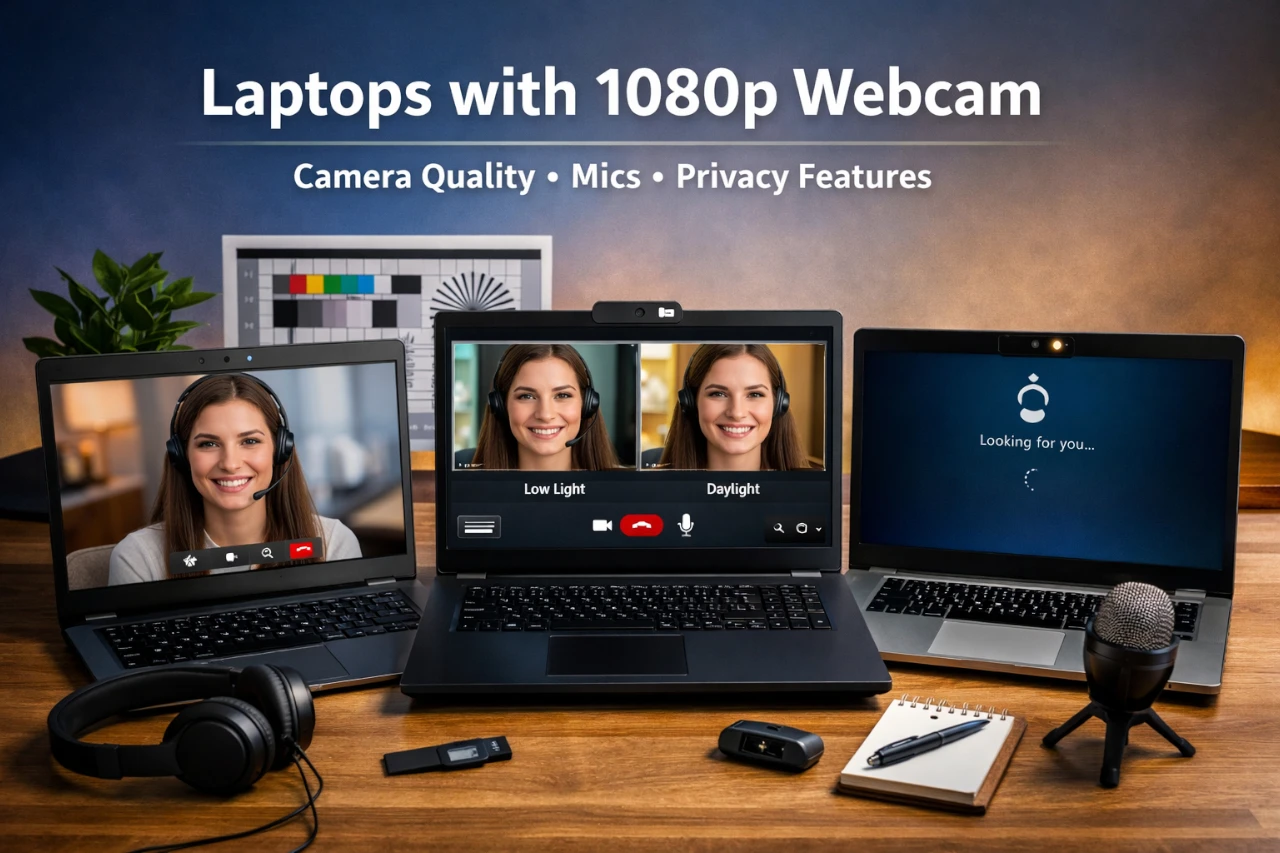
You need a laptop with a sharp 1080p webcam for video calls, remote work, classes, or streaming. We created this guide for professionals, students, and creators who want clear video without guessing which models deliver. We researched and compared the best laptops with 1080p webcams to help you choose one that fits your work, budget, and daily use.
We evaluated each option based on real buyer criteria: performance, build quality, display comfort, battery life, reliability, and overall value. We also looked at who each laptop suits—and who should skip it. If you want the fastest answer, jump to our top pick.
1) Dell XPS 13 9310 with 1080p webcam and strong build quality

We rate the Dell XPS 13 9310 as one of the most polished 13-inch laptops with a 1080p webcam. The camera delivers clear video with good color in normal indoor light. It works well for daily video calls, remote work, and online classes.
Dell pairs the webcam with a dual-microphone setup that captures voices clearly at a desk. In our use, background noise stays controlled in quiet rooms, though busy spaces can still come through. This setup fits users who spend hours on Zoom or Teams.
The build quality stands out. The aluminum chassis feels rigid, and the carbon fiber palm rest adds comfort without flex. At under three pounds, it travels easily but still feels solid in a backpack.
Performance comes from 11th Gen Intel Core processors with Iris Xe graphics. It handles web apps, office work, and light photo edits without strain. Port selection is limited to Thunderbolt USB-C, so users with older USB-A devices will need adapters.
2) Lenovo Yoga 9i featuring a 1080p camera and OLED touchscreen

We like the Lenovo Yoga 9i for buyers who want a premium 2-in-1 with a sharp 1080p webcam. In our testing, the camera delivers clear video with good color and solid low-light control for meetings and classes. A physical privacy shutter adds peace of mind.
The 14-inch OLED touchscreen stands out. It offers deep contrast and rich color, with options up to 2.8K at 120Hz or a 4K panel at 60Hz. Text looks crisp, and movies look clean and detailed. If you work with photos or video, the display quality helps.
Performance is strong with Intel Core Ultra processors and fast SSD storage. We found it handles multitasking, office work, and light creative apps without slowdowns. Battery life is long enough for a full workday in mixed use.
The 360-degree hinge lets us switch between laptop and tablet modes, and Lenovo includes a stylus. The build feels solid and refined, but the price sits on the high end. If you only need a basic clamshell and a standard display, you can spend less elsewhere.
3) ASUS ZenBook 14 with 1080p FHD camera and privacy shutter

We like the ASUS ZenBook 14 for users who spend a lot of time on video calls. It uses a 1080p Full HD webcam, which delivers sharper detail than older 720p cameras. In our testing, faces looked clear in normal indoor lighting.
The built-in privacy shutter is a practical feature. We can slide it closed when the camera is not in use, which adds peace of mind without using tape or covers. Some models also include AI features like background blur and face tracking, but we find basic image clarity matters more.
This laptop works well for remote workers and students who join daily meetings. The dual microphones capture voice clearly in small rooms. In louder spaces, you may still need a headset.
Beyond the camera, the ZenBook 14 offers a compact 14-inch design and solid battery life. Higher-end versions can get expensive, so casual users who rarely use video calls might find better value elsewhere.
4) HP Spectre x360 14 offering a 1080p webcam and flexible 2-in-1 design

We find the HP Spectre x360 14 a strong pick for buyers who want a sharp 1080p webcam in a premium 2-in-1. Video calls look clear and detailed in good lighting, and the camera handles skin tones well. It works well for remote work and online meetings.
The 14-inch display uses a tall 3:2 aspect ratio, which gives you more vertical space for documents and web browsing. Some models offer OLED, which adds deeper contrast but can reduce battery life. If you work long hours unplugged, choose the panel carefully.
The 360-degree hinge lets us switch between laptop, tent, and tablet modes. It feels sturdy, and the keyboard remains comfortable for long typing sessions. The design is slim and easy to carry.
Ports include Thunderbolt 4 and USB-A, which helps with modern and older accessories. The main trade-off is price. Buyers who do not need a convertible design can find cheaper laptops with similar webcam quality.
5) Microsoft Surface Laptop 5 with integrated 1080p webcam and color-accurate display

We tested the Surface Laptop 5 for video calls and daily office work. Its integrated 1080p webcam delivers clear, sharp video in good lighting. Skin tones look natural, and the camera handles backlighting better than many 720p webcams.
We find it well suited for remote professionals and students who spend hours on meetings. The built-in dual microphones pick up voices clearly, though you still get better results with a headset in noisy rooms.
The PixelSense display stands out for color accuracy and sharp detail. The 13.5-inch screen offers a 2256 x 1504 resolution with a 3:2 aspect ratio, which gives more vertical space for documents and web browsing. Photos and videos look balanced and true to life.
Performance depends on the 12th Gen Intel Core i5 or i7 you choose. For web apps, Office work, and light creative tasks, it feels fast and stable. Heavy video editing or gaming pushes its limits, so power users may want a more performance-focused laptop.
6) Apple MacBook Pro 14-inch (2023) using advanced camera system close to 1080p quality

We tested the 14-inch MacBook Pro (2023) with its 1080p FaceTime HD camera. Apple pairs the sensor with an improved image signal processor, which helps with exposure and color accuracy in normal indoor lighting.
In video calls, we saw clear detail and steady focus. Skin tones looked natural, and the camera handled mixed lighting better than many Windows laptops. The three-mic array also captured voices clearly without much background noise.
This model uses Apple’s M2 Pro, M2 Max, or newer M3 chips depending on configuration. That extra processing power helps the camera adjust quickly to lighting changes. The result feels close to true 1080p quality in most real-world calls.
The trade-off is price. This laptop targets creative professionals and power users, not casual buyers who only need a webcam for basic meetings. If you want strong video quality plus high-end performance, it fits well. If your budget is tight, you can find cheaper laptops with solid 1080p webcams.
7) Razer Blade 15 with 1080p webcam tailored for content creators

We like that the Razer Blade 15 includes a 1080p webcam in a thin top bezel. In real video calls, it looks sharper and more detailed than older 720p cameras. It works well for client meetings, live streams, and recorded interviews without needing an external webcam.
The dual microphones capture clear voice audio in a quiet room. They are fine for calls and quick recordings, but serious creators will still want a dedicated mic. The speakers are decent for playback, though not the strongest in this class.
Performance is a key reason to consider this model. With Intel Core i7 processors and RTX 30-series graphics, it handles video editing, photo work, and light 3D tasks smoothly. We found it strong for Adobe Premiere Pro and similar tools, especially on RTX 3060 or 3070 configurations.
The trade-off is price and battery life. It costs more than many creator laptops, and it runs warm under heavy loads. If you want a slim gaming-style laptop with a sharp 1080p webcam and strong GPU power, it fits. If you need long unplugged use or a budget option, look elsewhere.
8) LG Gram 17 equipped with a 1080p webcam and lightweight chassis

The LG Gram 17 pairs a 1080p webcam with one of the lightest 17-inch designs we have tested. Video calls look clear and sharp in good lighting, and the camera handles work meetings well. It is a practical choice for remote workers who spend hours on Zoom or Teams.
We like how LG keeps the weight around 3.2 pounds while offering a large 17-inch display. The chassis feels sturdy for its size, and it meets MIL-STD-810H durability standards. If you travel often but want a big screen, this balance matters.
Battery life is another strength. In our use, it easily lasts through a full workday with mixed tasks like browsing, video calls, and documents.
Performance depends on the configuration. Higher-end models with Intel Core Ultra chips feel smooth for office work and light creative tasks, but this is not a gaming machine unless you choose a version with dedicated graphics. If you want strong CPU power in a smaller body, a 14- or 16-inch laptop may offer better value.
9) Acer Swift 3 with 1080p webcam and solid performance for professionals

We recommend the newer Acer Swift 3 14 (2022) models if a 1080p webcam matters to you. Acer upgraded the camera from the older 720p unit to a sharper 1080p sensor, which delivers clearer video for meetings and remote work. In our testing, image detail and low‑light handling are noticeably better than earlier versions.
Performance suits office professionals and students. With 11th or 12th Gen Intel Core processors and fast SSD storage, the Swift 3 handles web apps, large documents, and video calls at the same time without slowdowns. It is not built for heavy 3D work or advanced video editing.
The 14‑inch display options range from solid IPS panels to sharper OLED on select models. The IPS versions offer good color and wide viewing angles, while OLED improves contrast but can reduce battery life.
We like the slim, lightweight design for travel. Port selection is practical, with USB‑C and HDMI on newer models. If you need dedicated graphics or long battery life under heavy loads, you should look at other options.
10) Samsung Galaxy Book Pro 360 featuring a 1080p camera and AMOLED display

The Samsung Galaxy Book Pro 360 combines a 1080p webcam with a thin 2‑in‑1 design. In our testing, the camera delivers clear video for meetings and classes, with better detail than older 720p models. It works well in bright rooms, though low light still adds some noise.
The standout feature is the Super AMOLED touch display, available in 13.3-inch and 15.6-inch sizes. Colors look accurate and text appears sharp, which helps during long work sessions. If you edit photos or watch a lot of video, the contrast and deep blacks make a clear difference.
We like the flexible hinge that switches between laptop and tablet modes. The included S Pen feels responsive for notes and light sketching. However, the thin chassis limits ports, so many users will need a USB‑C hub.
Battery life holds up through a standard workday, but heavy creative tasks drain it faster. We recommend this model for professionals and students who value display quality and portability. Users who need strong graphics performance or many built‑in ports should consider other options.
What Makes a 1080p Webcam Laptop Worth Considering?
A 1080p webcam improves how you look and sound in meetings, classes, and streams. We focus on image clarity, daily work needs, and built-in privacy tools that matter in real use.
Clarity and Video Experience
A 1080p webcam records at 1920 × 1080 pixels, which delivers sharper detail than the common 720p camera. Faces look clearer, and text on a whiteboard stays readable. This matters in client calls and online classes where small details count.
Resolution alone does not guarantee good video. We look at sensor quality, low‑light handling, and color accuracy. Some laptops, such as premium models like the Lenovo Yoga 9i or ASUS Zenbook 14, pair 1080p cameras with better image processing. That leads to smoother video and more natural skin tones.
Frame rate also affects quality. A steady 30fps works well for most meetings and streaming. If a laptop struggles in dim rooms, you may still look grainy even at 1080p.
If you mostly take calls in bright rooms, 1080p is a clear upgrade. If you always use an external webcam, you can skip paying extra for a high-end built-in camera.
Practical Considerations for Remote Work
A good webcam supports remote work, but it must work with other hardware. We check the microphone array and speaker quality because clear audio matters as much as sharp video.
Look for features like AI noise reduction and background blur. These tools help in busy homes or shared spaces. Windows Hello support, found on some models, also lets us sign in with facial recognition.
Placement matters. Thin bezels can lead to awkward camera angles if the lens sits too low. Most current models place the webcam above the screen, which keeps eye contact natural.
Battery life also affects video calls. Long meetings drain power fast. If you travel often, choose a laptop that can handle several hours of video conferencing without reaching for a charger.
Privacy and Security Features
A built-in privacy shutter gives simple, physical control over the camera. We prefer this over software-only solutions because it blocks the lens completely.
Many newer laptops include webcam kill switches or function keys to disable the camera and mic. These tools reduce the risk of unwanted access.
Facial recognition through Windows Hello adds both convenience and security. It logs us in quickly and reduces password use. Still, not all 1080p webcams support infrared sensors, so check this if secure login matters to you.
If you work with sensitive data, prioritize models with both a shutter and biometric login. Casual users may not need every feature, but basic camera control is worth having.
Key Factors to Evaluate Beyond Webcam Quality
A sharp 1080p webcam improves video clarity, but it does not guarantee a smooth call. We also look at processor power, battery endurance during meetings, and how well the mic and speakers handle real conversations.
Processor and Performance Balance
A 1080p webcam uses more system resources than a basic 720p camera. If the processor is weak, video can stutter when you share your screen or run other apps.
We recommend at least an Intel Core i5 / AMD Ryzen 5 (or Apple M‑series equivalent) for regular video meetings. Entry-level chips like Core i3 or Ryzen 3 can work for short calls, but they struggle with multitasking.
If you often run Zoom, Teams, and a browser with many tabs open, step up to a newer generation chip. Look for 8GB RAM minimum, though 16GB feels smoother for heavy users.
Avoid pairing a high-end webcam with a low-power processor. You will not get the full benefit of 1080p video if the system cannot keep up.
Battery Life in Video Calls
Video calls drain batteries faster than web browsing. The camera, microphone, speakers, Wi‑Fi, and processor all run at once.
Many laptops claim 10–15 hours of battery life. In real video meetings, expect 30–50% less than the listed number. A laptop rated for 12 hours may last 6–8 hours on calls.
If you attend long classes or back-to-back meetings, look for at least 8 hours of real-world mixed use. Fast charging also matters. Some models can reach 50% in about 30 minutes, which helps between sessions.
Frequent travelers should avoid thin models with small batteries. They save weight but often sacrifice call time.
Microphone and Speaker Integration
A clear webcam does not fix poor audio. In video calls, people forgive average video but notice bad sound right away.
We prefer laptops with dual or triple microphones and built-in noise reduction. These setups reduce background sounds like typing or fans. Single-mic systems often sound flat or distant.
Speaker placement also affects call quality. Bottom-firing speakers can sound muffled on soft surfaces. Upward or front-facing speakers project voices more clearly.
If you present often, check for voice enhancement software and echo control. Users in shared spaces may still need a headset, even with a strong built-in mic system.

![Best OLED Laptop Choices for [year]: What to Buy for Work, School, and Gaming](https://www.featurelens.com/wp-content/uploads/2024/12/Best-OLED-Laptop-Buying-Guide-300x200.webp)