
Gaming laptops make sense for players who want desktop-class speed in a machine they can move from a desk to a couch, dorm, or hotel. The hard part is balancing graphics power, screen quality, weight, heat, battery life, and price. A fast GPU matters most for modern games, but the display, cooling, and keyboard shape the experience just as much once we start using a laptop every day.
At the lower end, the best gaming laptops can still play popular shooters, esports titles, and many big-budget games at sensible settings, though memory and storage often need upgrades sooner. Midrange models usually hit the sweet spot, with enough GPU power for high settings and better screens. Premium systems add sharper displays, more thermal headroom, larger SSDs, and stronger build quality, though they also get heavier and less practical for travel.
For most people, the best gaming laptop is the one that pairs the right GPU with a good screen and cooling system, not simply the most expensive processor on the page.
Quick Picks
Best for high-end 16-inch gaming: ASUS ROG Strix G16
Best for value with ready-to-use specs: Acer Nitro V i7
Best for the lowest-cost entry point: Acer Nitro V i5
Best for strong QHD gaming value: MSI Katana 15 HX
Best for a large-screen premium setup: ASUS ROG Strix SCAR 18
1. ASUS ROG Strix G16


Buy this if you want one of the best gaming laptops for high-refresh 1440p-class play in a 16-inch size, and you are willing to carry a heavier system for better performance.
Pros
- RTX 5070 Ti and Core Ultra 9 give it serious gaming headroom
- 16-inch, 2560 x 1600, 240Hz display is a strong fit for fast games
- 32GB RAM means no immediate upgrade pressure
Cons
- Heavy for daily travel
- 1TB SSD is only average at this tier
- A few user reports mention stability issues, so early testing is wise
The Strix G16 hits the sweet spot for buyers who want premium gaming speed without moving up to an 18-inch machine. In real use, the 16:10 screen gives us more space for work and browsing than a standard 15.6-inch panel, and the 240Hz refresh rate makes fast shooters feel smooth.
Its cooling setup is a big part of the appeal. ASUS is clearly aiming for sustained performance, not just short bursts. That matters more than headline specs when we are in a long game session.
The trade-off is portability. At just over six pounds, this is closer to a transportable gaming laptop than a casual carry-around model. Battery life for gaming is limited, as expected, though light use on integrated graphics should stretch further.
2. Acer Nitro V i7

Buy this if you want one of the best gaming laptops for value and you need a machine that is ready to use without immediate RAM or storage upgrades.
Pros
- Good value with 16GB RAM and 1TB SSD
- RTX 4050 is enough for esports and many AAA games at sensible settings
- Useful port mix, including Ethernet and Thunderbolt 4
Cons
- FHD resolution is less sharp than QHD rivals
- Battery life appears weak in real use
- RTX 4050 limits ray tracing and ultra-setting ambitions
This Nitro V is the practical pick for many buyers. The RTX 4050 is not a high-end GPU, yet it is still a capable one when paired with a 1080p, 165Hz screen. That pairing makes sense. We would rather see a midrange GPU driving FHD well than struggling to justify a higher-resolution panel.
The i7 processor, 16GB of RAM, and 1TB SSD make this version much easier to recommend than cheaper starter models. There is less need to spend extra right away.
Its compromises are easy to spot. The display is fast, not luxurious, and reported battery life is poor enough that we would treat this as a plug-in-first machine. For students or buyers on a firm budget, it remains a strong value choice.
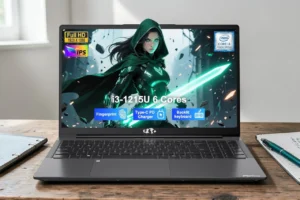
3. Acer Nitro V i5

Buy this if you want the lowest-cost route into modern PC gaming and do not mind upgrading memory soon.
Pros
- Lower-cost entry to RTX 4050 gaming
- Same 165Hz FHD screen concept as the pricier Nitro V
- RAM and storage can be expanded later
Cons
- 8GB RAM is too tight for many modern games
- 512GB SSD fills quickly
- CPU is fine for budget gaming, not ideal for heavier multitasking
This is the budget version that makes sense only if the low price is the main reason we are shopping. The RTX 4050 still gives it a real gaming foundation, which is more important than having a flashy processor in this class.
The problem is the starting memory and storage. An 8GB setup can lead to stutter in newer games and a less smooth experience when we have launchers, chat apps, and browser tabs open. Several buyers have already pointed out that adding RAM helps a lot, and we agree that this should be part of the plan.
If we can spend a bit more, the i7 Nitro V is the easier recommendation. If we cannot, this model still works as a starter system, especially for Fortnite, Valorant, Rocket League, Minecraft, and older AAA games.
4. MSI Katana 15 HX

Buy this if you want one of the best gaming laptops for QHD gaming value and care more about frame rates and display sharpness than battery life.
Pros
- RTX 5070 and QHD 165Hz screen are a smart match
- 32GB RAM and 1TB SSD are generous for the class
- Plenty of ports, including Ethernet and multiple USB-A ports
Cons
- Battery life is very short
- Heavier and thicker than many mainstream 15-inch laptops
- User feedback is positive, though MSI quality consistency is still worth noting
This Katana 15 HX stands out because the core package makes sense. A 15.6-inch QHD-class display gives us a clear visual step up from FHD, and the RTX 5070 is better placed than an RTX 4050 to take advantage of that extra resolution.
The i9 processor is powerful, though many buyers will benefit more from the GPU and 32GB RAM than from the top-end CPU itself. That is not a complaint, just a reminder that this machine is built as a performance-first notebook.
Its weak point is mobility. MSI lists very short battery life, and that aligns with what we expect from a high-power HX system. If we are mostly gaming near an outlet, this is one of the better values in the upper midrange.
5. ASUS ROG Strix SCAR 18

Buy this if you want one of the best gaming laptops as a desktop replacement, with a huge screen, top-tier GPU, and fewer compromises on display quality.
Pros
- 18-inch 2.5K 240Hz Mini LED display is the best screen here
- RTX 5080 and strong cooling target serious high-end gaming
- 2TB SSD and Windows 11 Pro suit premium buyers well
Cons
- Large and heavy, not ideal for regular travel
- Very expensive for most shoppers
- Some user feedback raises build-quality concerns at this price
The SCAR 18 is the least portable option in this roundup, and that is exactly why some buyers will want it. An 18-inch screen changes how games, creative work, and even basic multitasking feel. We get more immersion than on a 15-inch model, and the Mini LED panel should deliver better contrast than standard IPS screens.
This is the machine for buyers who would otherwise consider a small desktop. The cooling system, large chassis, RTX 5080, and 2TB SSD all point in that direction.
That premium pitch also raises expectations. When a laptop costs this much, even small build complaints matter more. We would buy it for its display and performance, not for portability or value.
Buying Guide
Choosing the best gaming laptops starts with one simple question: what kinds of games do we actually play? A laptop for Valorant and League of Legends is a very different purchase from one meant for Cyberpunk 2077, Black Myth: Wukong, or video editing alongside gaming.
Match the GPU to Your Games
The GPU should lead the buying decision.
| GPU Tier | Best For | What to Expect |
|---|---|---|
| RTX 4050 class | Esports, indie games, older AAA titles | Best at 1080p, often medium to high settings |
| RTX 5070 class | New AAA games, higher settings, QHD gaming | Better long-term value, more room for ray tracing |
| RTX 5070 Ti and above | High-refresh QHD, premium gaming | Better fit for demanding games and faster displays |
| RTX 5080 class | Desktop-replacement use | Strongest performance, highest cost and heat |
A fast CPU helps, especially for strategy games, simulation games, and streaming. Still, most gamers will feel GPU upgrades more than CPU upgrades.
Do Not Ignore the Display
A gaming laptop screen affects every minute of use.
Look for these basics:
- 1080p at 144Hz or 165Hz for budget and midrange systems
- 2560 x 1600 or 1440p-class panels for stronger GPUs
- 16:10 aspect ratio if you also work, browse, or study on the laptop
- Higher brightness and better color if you care about image quality, not just speed
A weak GPU paired with a high-resolution display can be a bad match. That often means lowering settings more than expected.
Memory and Storage Matter More Than Many Buyers Expect
For 2026, we consider 16GB RAM the practical minimum for a gaming laptop. With 8GB, background apps and newer games can create stutter or long load times.
For storage:
- 512GB works only if we keep a small game library
- 1TB is the better starting point
- 2TB is ideal for large AAA installs and creative files
Upgrade access is worth checking before buying, especially on lower-cost models.
Think About Heat, Fan Noise, and Weight
Thin gaming laptops look nice in listings. They can still run hot, loud, or both.
If we play at a desk most of the time, a heavier chassis can be a good thing because it usually allows better cooling. If we commute every day, dropping a pound or more from the carry weight matters.
Ports and Wireless Are Easy to Overlook
A useful gaming laptop should have enough ports for real use.
We like to see:
- USB-C or Thunderbolt for docks and displays
- HDMI for a monitor or TV
- Ethernet for stable online gaming
- Enough USB-A ports for mouse, headset, and storage
- Wi-Fi 6E or Wi-Fi 7 on pricier models
Battery Life Is Not the Main Reason to Buy One
The best gaming laptops can last a decent amount of time for web browsing or video playback if they switch to integrated graphics. During actual gaming, battery life is still short on most models. It is better to think of battery performance as a bonus, not the reason to choose a gaming system.
Final Recommendations
If we wanted the best balance of premium performance, screen quality, and everyday usability, we would choose the ASUS ROG Strix G16. It offers the strongest all-around mix in this group without jumping to the size and cost of an 18-inch desktop replacement.
If value matters most, the Acer Nitro V i7 is the smart buy. It has enough memory and storage to feel complete on day one, and its RTX 4050 makes sense with its 1080p screen.
If we were shopping as cheaply as possible and were comfortable upgrading memory, the Acer Nitro V i5 is the entry pick. It is the most compromise-heavy option here, though it still gets us into real PC gaming.
If we wanted sharp QHD gaming without paying for a flagship machine, we would look closely at the MSI Katana 15 HX. It is a plug-in-first laptop with short battery life, though its screen and GPU pairing are compelling.
If our goal was a true desktop replacement with the biggest and best display in the roundup, the ASUS ROG Strix SCAR 18 would be the premium choice. It is expensive and bulky, yet it is also the clearest pick for buyers who want maximum immersion.